or

By signing in, I accept the Rebuildetroit.com Terms of Use.

Agent Registration

Find Your Agent Profile

Agent Registration

Berry Gordy: the Hitmaker Who Gave Detroit Soul

313 Legends

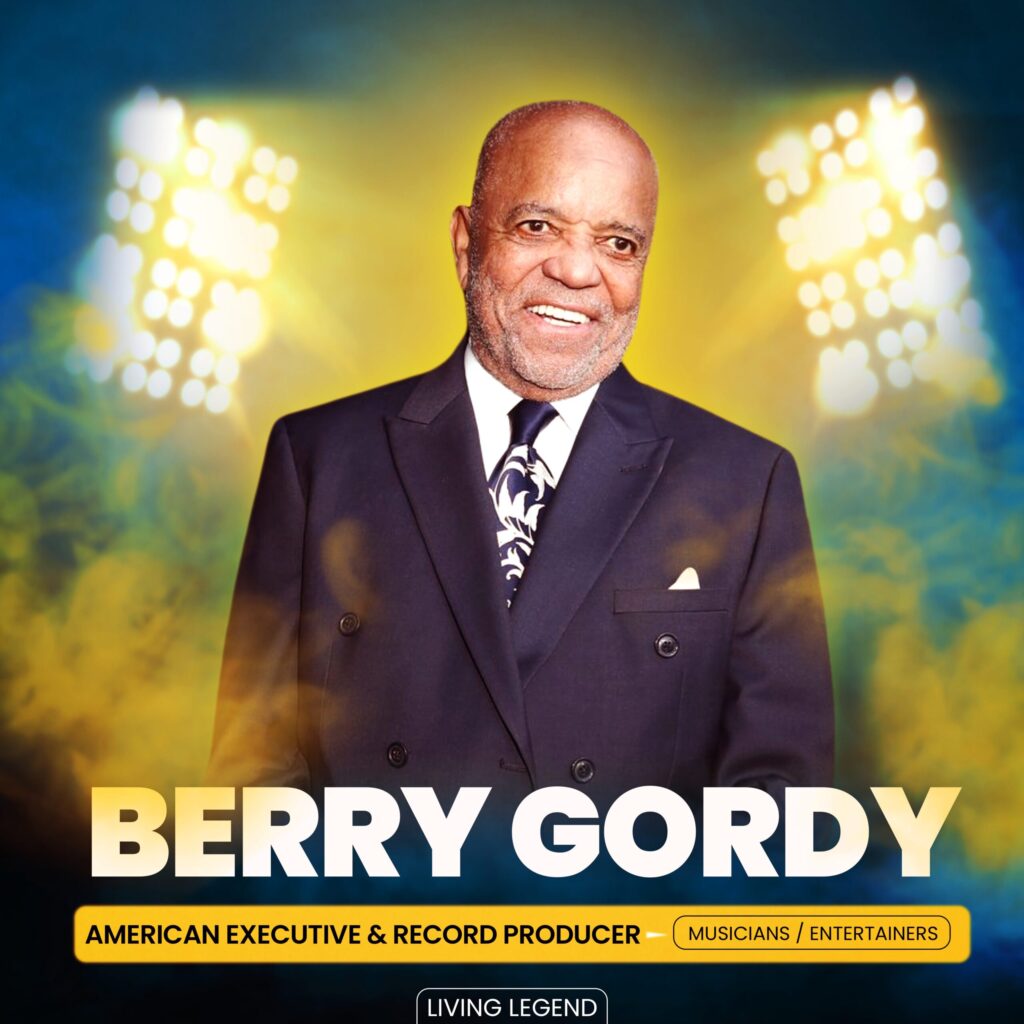
Berry Gordy

Living Legend

Berry Gordy: the Hitmaker Who Gave Detroit Soul

Born: 28 November 1929 - Detroit, Michigan.

Notable Date: Founded Motown Records on January 12, 1959.

Detroit Years: 1929-1972 - Motown relocated to Los Angeles officially in 1972.

Legacy: Founder of Motown Records, architect of the Motown Sound, and mentor to music legends.

Introduction

A little known fact about Berry Gordy is that long before he became a musical legend, he was a boxer, fighting in Detroit rings in his early 20s ahead of launching the most iconic Black-owned label in American music. 

And although boxing did not last, the spirit of competition stuck with Gordy.

Today, when the world thinks of Detroit, they think of Motown…and yet, the label never would have gotten off the ground had it not been for Berry Gordy’s input.

Born to Hustle

Gordy was the seventh of eight children in a large, entrepreneurial Black family in Detroit, born on November 28, 1929. 

His father had a plastering and carpentry business, and his mother sold insurance and had a grocery store. 

They expected the same kind of hustle from their children, and Berry delivered, restless from the jump.

School bored him.

Boxing thrilled him. 

And music ran through his blood like something sacred and ancestral. 

Berry left Northeastern High School in the 11th grade and earned a GED. 

He was drafted into the US Army in 1951 and served until 1953, first in the 58th Field Artillery Battalion and later as a chaplain’s assistant.

The Berry Gordy who returned from the Korean War was sharper and focused: He didn’t want to punch in and out for work. 

What he yearned for most was full control of something he could call his own.

From Ford to Fame

Like many Detroiters of the era, Berry ended up at Ford Motor Company’s Lincoln-Mercury plant.

On the assembly line, he wired chrome onto Cadillacs while melodies played on an endless loop in his head. Later, he would call the line his best education – because it taught him processes, rhythms, and efficiency.

How Ford built cars?

That was how Berry Gordy built hits.

He hung around record stores, jazz clubs, and the local R&B scene, where he began writing gritty, catchy songs with attitude and strong hooks.

That said, his big breakthrough came in 1957 when Gordy co-wrote “Reet Petite” with Jackie Wilson, followed by memorable hits like “Lonely Teardrops.”

Fame had finally arrived, yet In Berry’s eyes, writing was just another way to watch other people make money.

What he wanted most was ownership.

Hitsville, U.S.A

With an $800 loan from his family, Berry Gordy founded Tamla Records in January 1959, followed by the iconic Motown Records the following year. 

Both labels were amalgamated to become Motown Record Corporation, headquartered at 2648 West Grand Boulevard in a small two-story house known as Hitsville USA.

That name was nothing to take lightly. 

Gordy would go on to start a revolution from that little house.

He built something no one else in music had ever attempted: a bridge.

A hit factory for emerging Black talent that managed to cross over into Hollywood and top the charts.

It wasn’t just about music – he was producing culture. 

The Motown Sound

If you’ve ever tapped your foot to The Supremes, danced to Marvin Gaye, cried to Smokey Robinson, or hummed Stevie Wonder while driving on a lonely highway – you know it: that sound.

It’s sweet but bold. 

Gospel-rooted, pop-polished. 

Funky, yet radio safe. 

And above all else…all Gordy’s handiwork.

His philosophy was one part assembly line, one part spiritual alchemy. 

The departments he built were corporate in nature: songwriting teams, producers, choreographers, and even a charm school to teach etiquette and diction.

Each player played their part.

Everyone worked hard. 

And Berry Gordy watched everything with an extreme eye for detail, refining anything he viewed as raw. 

Diana Ross was just another girl from the projects until she saw a star.

Stevie Wonder was a blind child prodigy. 

Smokey Robinson? His right-hand man. 

Marvin Gaye? A tortured genius whose mentor (his own father, who would later go on to infamously take his life in 1984) was much of the same.


Berry Gordy built each one of them up into the megastars the world would come to know them as, and between 1961 and 1971, Motown had more than 110 Top 10 hits on their hands – 15 of which were number one. 

Detroit, Then and Now

Motown didn’t just remake music.

It redefined Detroit as a musical capital.

At a time when the city was racially charged, economically split, and civil unrest was at an all time high, Gordy built a company that gave young Black artists work, dignity, and agency.

For an auto industry city, he gave Detroit something else to be known for: rhythm.

He also employed hundreds, from musicians to seamstresses to engineers, janitors, backup singers, and everything in between.

Under his leadership, Motown continued to be the emblem of Black Detroit pride even as riots erupted in 1967 and white flight destroyed entire neighborhoods. 

But even greatness comes with an expiration date.

Leaving Detroit

Things were changing in Detroit by the early 1970s. 

The Civil Rights Movement had evolved. 

Motown began to lose its shine amidst the Black Power movement, Vietnam, and other cultural changes, especially as its artists began to desire greater autonomy.

Marvin Gaye fought for “What’s going on”

Stevie Wonder demanded artistic control.

And Diana Ross went Hollywood.

So Berry made some changes of his own. 

In 1972, he moved Motown’s headquarters to Los Angeles to pursue new markets and even a few movie ideas. 

In a sense, Detroit was left behind, but when one door closes, another one opens.

Life After Motown

Gordy started Motown Productions with The Last Dragon (1985). 

He remained influential but never reached the heights of the ’60s, eventually selling Motown for $61 million by 1988.

He was then inducted into the Rock and Roll Hall of Fame in 1990, awarded the National Medal of Arts in 2016, and honored in the Kennedy Center in 2021 before going on to start the Motown Museum at the old Hitsville house, where fans from all around the world now come to touch the walls where miracles occurred.

Legacy

Berry Gordy didn’t just give Detroit a soundtrack.

He gave it a new identity entirely, proving black artists could dominate pop without losing their soul.

He’s sharp, controversial, and sometimes controlling. 

Yet history agrees: he’s the man who made the Motown movement possible.

About the Author

Victoria Jackson

Victoria Jackson (Editor In Chief)

Victoria Jackson is a lifelong student and sharp-eyed documentarian of all things Detroit, from its rich musical roots and cultural icons to its shifting neighborhoods, storied architecture, and underground legends. With her finger firmly on the pulse of both the city’s vibrant past and its rapidly unfolding future, she brings a deeply personal, historically grounded lens to every piece she writes.

Published on: July 25, 2025