or

By signing in, I accept the Rebuildetroit.com Terms of Use.

Agent Registration

Find Your Agent Profile

Agent Registration

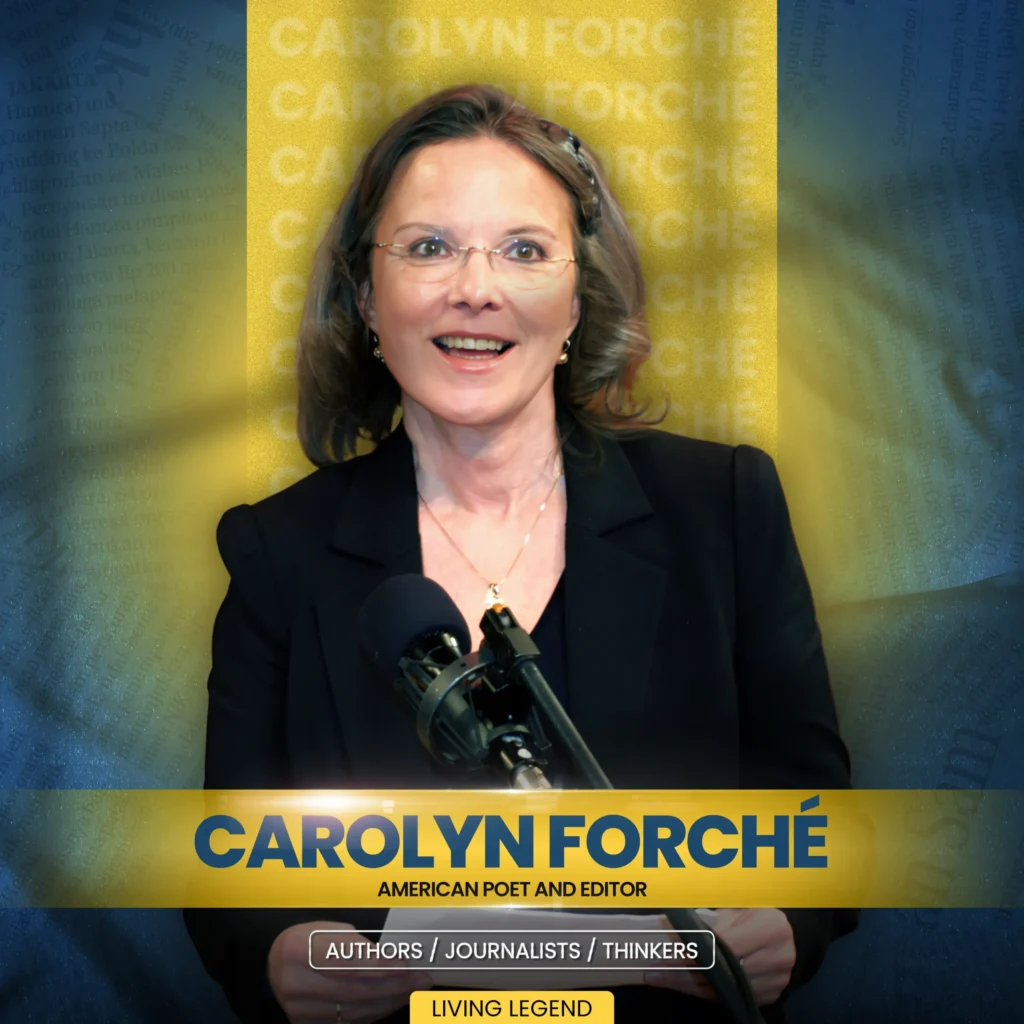
Carolyn Forché: Poet and Witness

313 Legends

Carolyn Forché

Living Legend

Carolyn Forché: Poet and Witness

Born: April 28, 1950, Detroit, Michigan
Detroit Era: 1950–1970
Legacy: Internationally recognized poet, translator, teacher, and activist.

Introduction

Carolyn Forché has dedicated her entire life to what she calls “poetry of witness”—verses that refuses to turn away from violence, injustice, and history’s darkest truths.

She is one of the most significant literary voices to ever come out of Detroit, a writer who learned early on that silence in the face of corruption is cowardice.

The Early Years That Shaped a Great

Carolyn Forché was raised in a working-class household on the west side of Detroit.

Her dad worked as a tool-and-die maker for General Motors, while her mother was a homemaker.

It was a time when the city was full of industry, hardworking immigrant families, and racial and class divides.

The Detroit Carolyn knew in the 1950s was both vibrant and deeply fractured – an industrial powerhouse with serious inequities.

With its mix of cultural chaos and resilience, those early years in Detroit helped Carolyn develop a sensitive understanding of human struggle that would go on to define her work later in her later years.

As a method of coping, she took refuge in books, spending her time at the Detroit Public Library, which opened up portals to other worlds and taught her poetry as a language of resistance- eventually leading to her studying creative writing at Michigan State University.

As an undergraduate, Carolyn became attracted not only to the lyrical composition of poetry but to the moral weight it was capable of carrying.

She saw writing as a method of confronting history, not escaping it, further expanding her creative talents through her time spent working overseas in places like South Africa, El Salvador, Lebanon, and Spain, places where violence was always right around the corner and testimony was dangerous.


The Poetry of Witness

In 1978, Forche went to El Salvador on a Guggenheim fellowship.

There, she witnessed the cruelty of a nation heading toward civil war.

Friends and families were at odds, towns were burning, and voices were muted – yet Carolyn wrote what she saw – refusing to make her poems distant or safe.

From this came her book “The Country Between Us” (1981), which deeply moved and disturbed her readers.

Both ferociously political and humane, it documented terror while also mourning it, serving as a “poetry of witness” that proved words alone can sometimes be enough to fight back.

Her subsequent publications, “The Angel of History” and “Blue Hour,” further extended that vision to historical and international levels, combining Holocaust testimony, war memory, and spiritual longing into a body of work that challenged the boundaries of poetry itself.

Chronicler, Teacher, Translator

Most of Forche’s career involved enhancing other voices.

She has taught everywhere from Georgetown, San Diego State, and Wayne State, and her translations then reached English-speaking audiences, including Nicaraguan poet Claribel Alegria and French surrealist Robert Desnos.

Her translations have the same urgency as her own poems: they demonstrate that words are alive and capable of resisting erasure.

Memoir and Later Recognition

Carolyn released “What You’ve Heard Is True” in February 2019, a book that reads more like a testimony than a memoir – an honest account of how a young poet was seduced by revolution and repression – a piece of work that elevated her from a poet to a historian.

From Detroit’s west side to the front lines of international conflict, Carolyn has never been afraid of staring down conflict head on.

She has raked in many honors thanks to that quality, including Guggenheim and NEA fellowships, a Lannan Literary Award, and the Windham-Campbell Prize.

That said, Carolyn’s awards do not define her as much as her persistence that art must exist alongside conscience does.

For Detroit, she’s a daughter of the Motor City that has carried its strength into the world at large, proving that poetry can be a form of testifying, fighting back, and enduring.

About the Author

Victoria Jackson

Victoria Jackson (Editor In Chief)

Victoria Jackson is a lifelong student and sharp-eyed documentarian of all things Detroit, from its rich musical roots and cultural icons to its shifting neighborhoods, storied architecture, and underground legends. With her finger firmly on the pulse of both the city’s vibrant past and its rapidly unfolding future, she brings a deeply personal, historically grounded lens to every piece she writes.

Published on: August 23, 2025