or

By signing in, I accept the Rebuildetroit.com Terms of Use.

Agent Registration

Find Your Agent Profile

Agent Registration

Charles McGee: Detroit’s Living Line

313 Legends

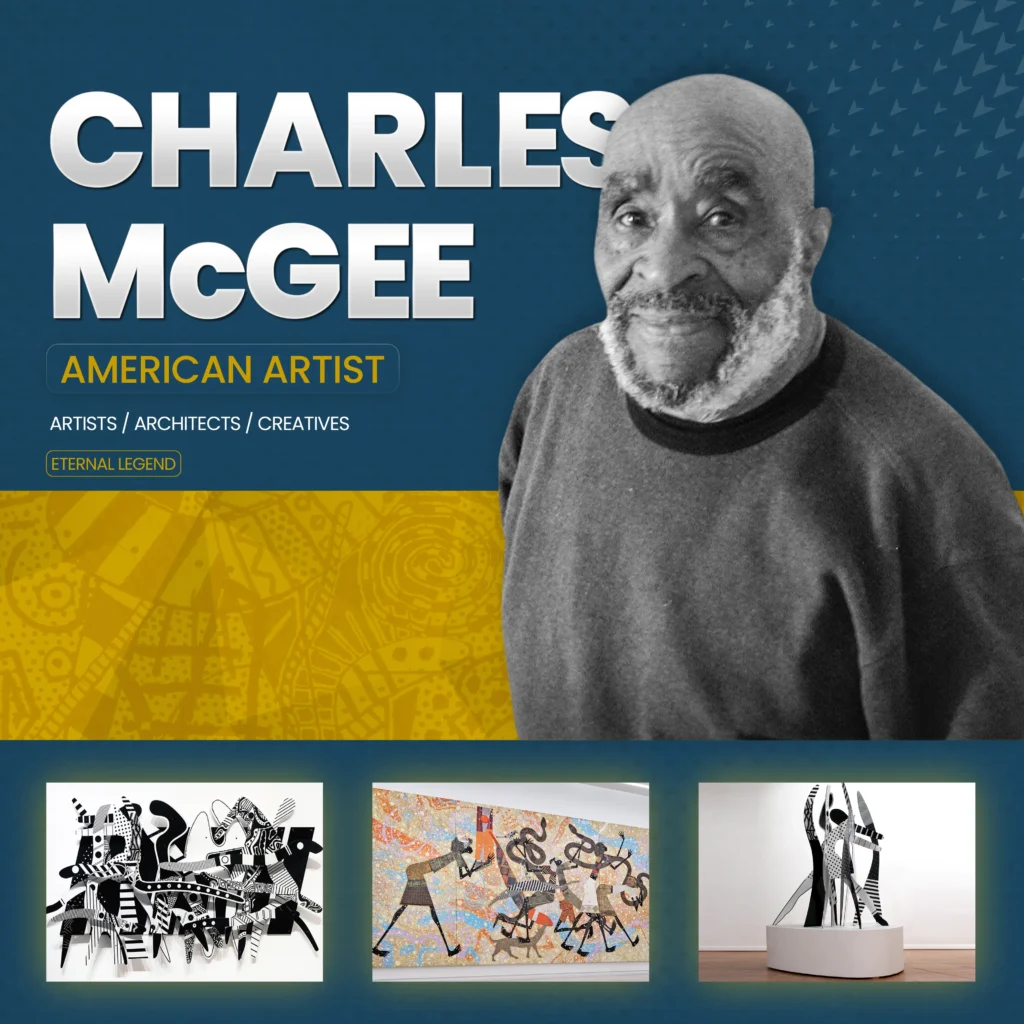
Charles McGee

Eternal Legend

Charles McGee: Detroit’s Living Line

Born: 15 December 1924, Clemson, South Carolina.

Died: 4 February 2021, Detroit, Michigan.

Detroit Era: 1934-2021

Legacy: Pioneering black art in the Midwest, co-founder of the Contemporary Art Institute of Detroit, creator of public works including "Unity" and "Still Searching," mentor to generations of artists, and a lifelong champion of the city's creative pulse.

Introduction

As you walk through Detroit, you’ll feel like you’re walking into Charles McGee’s imagination.

His legacy is on freeway overpasses, museum walls, school corridors – and in the quiet disbelief of Detroit students who grew up thinking a career in art was impossible yet necessary.

He never chased fame.

The truth he sought was in form.

Although born just outside the Motor City, McGee paid back the city that molded him in murals, mentorship, and magic.

From Sharecropping to Shape-Making

The young Charles McGee was born in Jim Crow South Carolina in 1924 and recalls red dirt, cotton fields, and picking with his mother for food and survival.

At the age of 10, his family moved with the Great Migration to Detroit, marking the first time he ever saw a paved road.

Detroit in the 1930s was no paradise – but it offered grit, rhythm, possibility, and most importantly, space to imagine.

Young McGee did not attend art school. 

Instead, he drew on scraps, napkins, and paper bags.

What he saw, he sketched: horses, buildings, faces, struggles. 

In World War II, he served as a United States Marine and was assigned duty to clean up Nagasaki after the bomb.

He then entered the College for Creative Studies, graduating in 1967 and returning to teach there for more than two decades.

Art as Ecosystem

McGee’s style was unmistakable:

Bold lines. 

Interlocking forms. 

Urban Hieroglyphic merged with African diasporic geometry.

His work was layered and abstract – like dancing puzzle pieces.

He thought all things were interconnected: nature, jazz, struggle, and celebration – all in one composition.

He once said:

He once said, “The universal language is art. And it speaks across cultures and across time.”

In his hands, that became Detroit’s dialect.

McGee produced work until he was 96 – nearly 80 years of unbroken creativity.

He painted, collaged, and sculpted during Detroit’s turbulent 1960s and 70s, which saw civil rights marches, white flight, and the ’67 uprising.

His Contemporary Art Institute of Detroit was founded in 1978 to showcase his work and challenge the gallery system, but his public art really exploded around the city in the 2000s:

McGee’s piece, “Unity” (2017), is on the side of the Charles H. Wright Museum, celebrating connection through difference.

“Still Searching” (2016) is in The Detroit Institute of Arts.

And his mixed-media pieces are in the Whitney, Detroit Institute of Arts, Smithsonian, and MoMA permanent collections.

That said, his art was not what made McGee most remarkable.

It was his humility.

He thought artists and their work must be near people – never above them.

In that way, McGee was a guardian of artistic lineage.

Informally, he taught thousands through CCS and various projects, panels, and random encounters, and his work is cited by various artists including Tyree Guyton, Tiff Massey, and Sydney G. James.

The man never spoke.

He listened. 

He encouraged.

He wanted Detroit’s next wave to go beyond what just he had done, and young artists who visited his studio found a man still experimenting – sculpting wire into thought, painting with childlike curiosity, refusing to become cynical.


Detroit in His Bones

McGee never left Detroit – not for New York, not LA, not for fancy galleries that didn’t fully 

“get” him.

He said the city gave him everything he needed: his urgency; his palette; his people.

In short, he was not a product of the system.

He built systems for others.

He survived the riots, the abandonment, the bankruptcy, the comeback. 

And during every phase, he asked himself and others: “What do you want to make out of your struggle?”

Final Word: The Infinite Line

Charles McGee said life was like a spiral – not linear, but circular – always folding in on itself.

His work reflected that.

It never ended.

It just kept changing, evolving, and building.

In short: he was more than just a Detroit artist.

He was quiet, warm, and unshakable.

If you stay long enough in one of his pieces, the city speaks, and you realize:

This isn’t chaos. 

It’s choreography.

A rhythm strummed by a man who saw things connect and refused to forget his roots.

About the Author

Victoria Jackson

Victoria Jackson (Editor In Chief)

Victoria Jackson is a lifelong student and sharp-eyed documentarian of all things Detroit, from its rich musical roots and cultural icons to its shifting neighborhoods, storied architecture, and underground legends. With her finger firmly on the pulse of both the city’s vibrant past and its rapidly unfolding future, she brings a deeply personal, historically grounded lens to every piece she writes.

Published on: June 26, 2025