or

By signing in, I accept the Rebuildetroit.com Terms of Use.

Agent Registration

Find Your Agent Profile

Agent Registration

Dennis Coffey: Detroit’s Funk Man Innovator

313 Legends

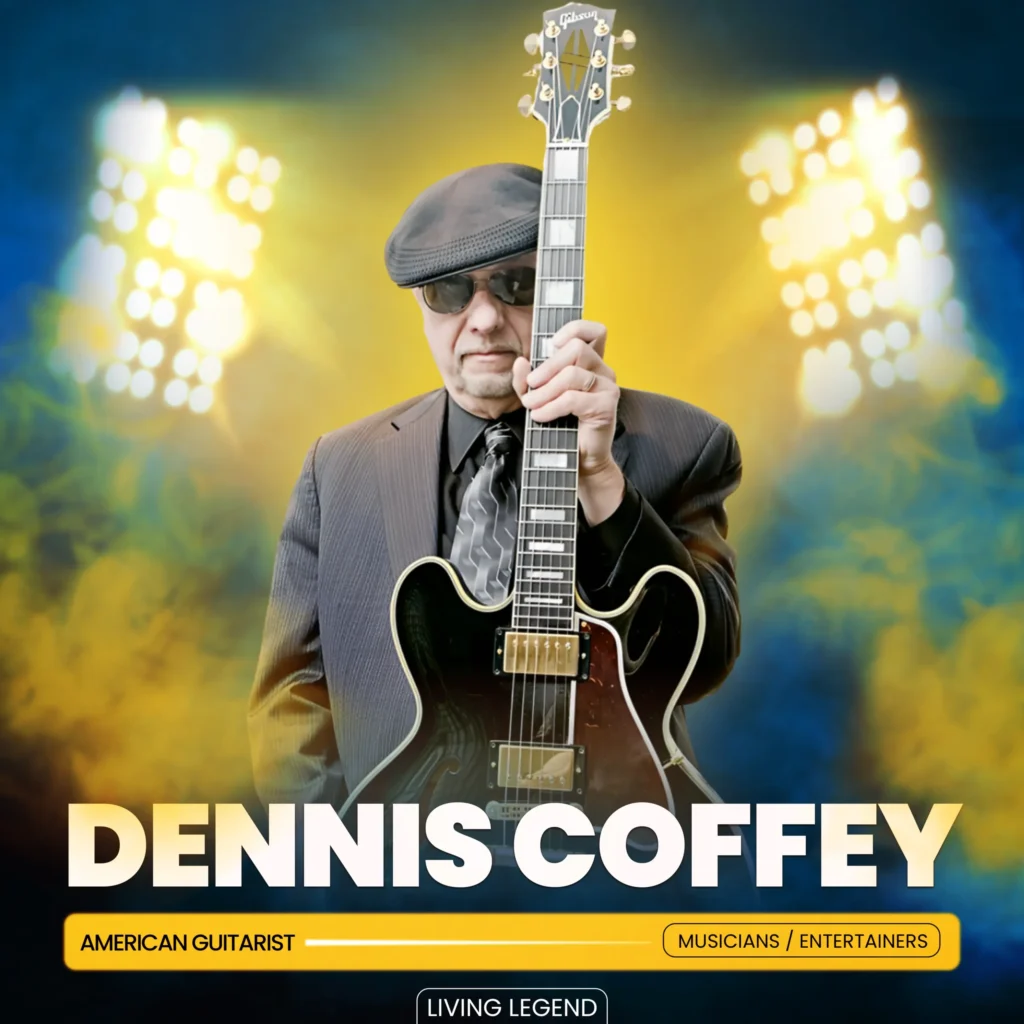
Dennis Coffey

Living Legend

Dennis Coffey: Detroit’s Funk Man Innovator

Born: November 11, 1940, in Detroit, Michigan
Detroit Era: 1940–present
Legacy: Esteemed session guitarist, solo R&B and soul artist, producer who helped shape Motown's late-1960s and early-1970s sound, and arranger known for his wah-wah riffs and psychedelic textures.

Introduction

A member of the Funk Brothers, Dennis Coffey brought rock, funk, and electronic experimentation into soul music, most famously on hits like The Temptations’ “Cloud Nine” and his own “Scorpio” – one of those rare musicians whose name is written all over American popular music but not always heard by listeners.

He turned Motown into funk and gave Detroit an entirely new sound.

Detroit Beginnings

Coffey was raised on Detroit’s west side and played guitar as a child, developing an early love of jazz, country, and the blues.

By his teenage years, he was playing clubs and sampling Detroit’s many musical styles, fusing Motown, rock & roll, R&B, and jazz into his own signature sound.

From there, Coffey signed on with Motown’s Funk Brothers in the late 1960s just as the label was moving from polished soul to funkier, more socially conscious material.

He can be heard playing guitar riffs on The Temptations’ “Ball of Confusion,” “Psychedelic Shack,” and “Cloud Nine” – songs full of trippy psychedelic effects like fuzz tones, distortion, and the wah-wah pedal that defined Motown for an entire new decade and brought a real countercultural vibe that would propel soul music towards funk and hip-hop.


Solo Career and "Scorpio"

Coffey stepped out on his own for the very first time in 1971, his instrumental funk jam “Scorpio” even reaching the Billboard Top 10.

The genre-defying track would later be sampled by Public Enemy, Young MC, and Queen Latifah, further cementing Coffey’s trailblazer status.

From there, he debuted two solo albums: “Evolution” (1971) and “Electric Coffey” (1972) – both of which highlighted him not only as a guitarist, but as a free spirit in a musical league all of his own.

Producer, Arranger, and Mentor

Beyond performing, Coffey became a producer and arranger.

During his time on the Westbound label, he played with Detroit soul acts such as Funkadelic and contributed his psychedelic guitar to their pioneering funk sound, producing a number of local groups that would shape Detroit long after Motown’s golden age ended.

Coffey would then record and perform well into the 2000s, releasing albums that celebrated his Funk Brothers history and his forward-thinking creativity.

He even released an autobiography, “Guitars, Bars & Motown Superstars,” which chronicled Detroit’s musical revolution firsthand.

Detroit's Influence

Everything about Coffey reflects Detroit: his combination of hard-driving rhythm (a nod to the city’s factories), his willingness to cross genres (Motown meets funk meets rock), and insisting on groove above all else.

He represents how the city can reinvent its sound without losing its soul and grit.

Whilst Dennis Coffey’s wah-wah guitar was an experiment, it became part of modern music DNA, with his playing crossing generations and genres, from Motown classics to hip-hop samples.

For Detroit, he was the spark plug that turned soul into something bolder, funkier, and infinitely more influential.

About the Author

Victoria Jackson

Victoria Jackson (Editor In Chief)

Victoria Jackson is a lifelong student and sharp-eyed documentarian of all things Detroit, from its rich musical roots and cultural icons to its shifting neighborhoods, storied architecture, and underground legends. With her finger firmly on the pulse of both the city’s vibrant past and its rapidly unfolding future, she brings a deeply personal, historically grounded lens to every piece she writes.

Published on: September 3, 2025