
or

By signing in, I accept the Rebuildetroit.com Terms of Use.

Agent Registration

Find Your Agent Profile

Agent Registration

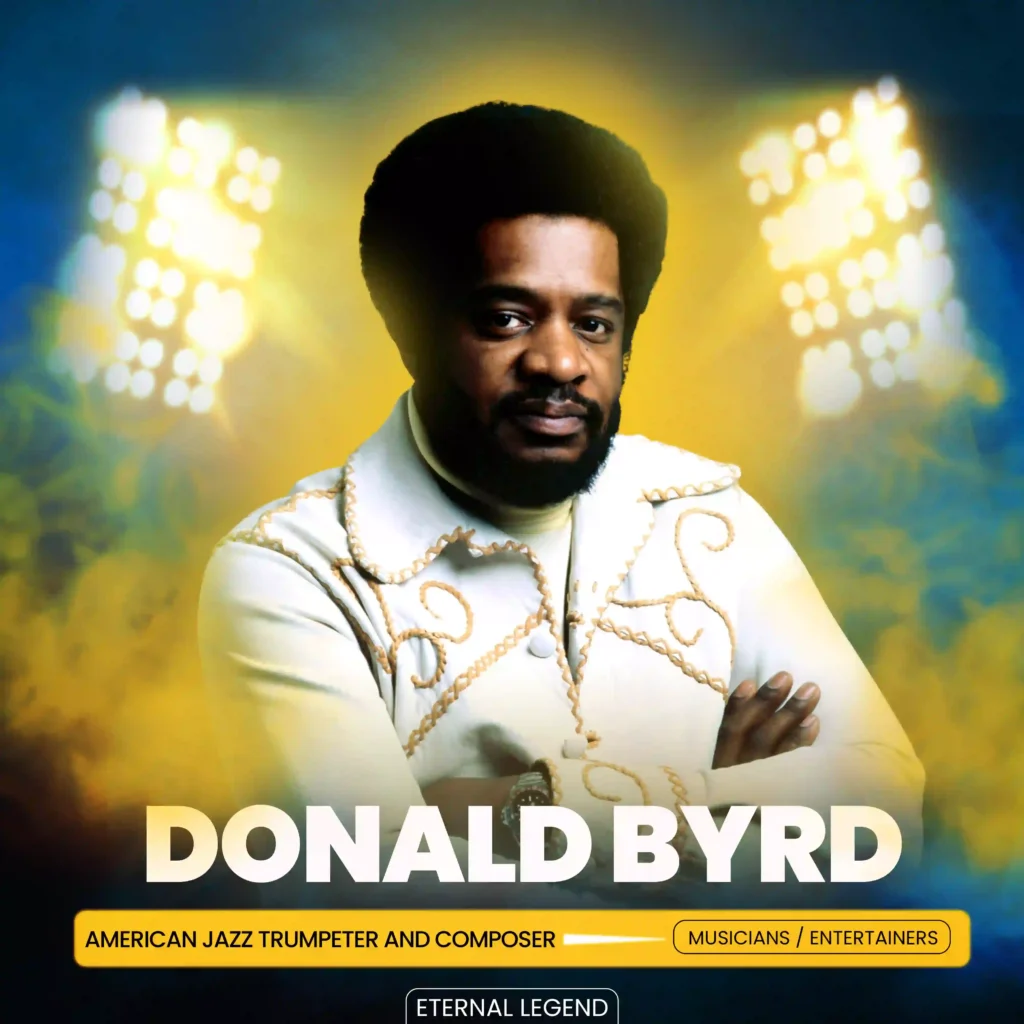
Donald Byrd: Detroit’s Hard Bop Innovator

313 Legends

Donald Byrd

Eternal Legend

Donald Byrd: Detroit’s Hard Bop Innovator

Born: December 9, 1932, Detroit, Michigan
Died: February 4, 2013, Dover, Delaware
Detroit Era: 1932–early 1950s (formative years)
Legacy: Trumpeter, composer, educator, and one of the most versatile figures in modern jazz. Byrd moved fluidly from hard bop to soul jazz to funk-infused fusion, expanding the vocabulary of the trumpet while bringing jazz into classrooms and communities.

An Authentic Detroit Upbringing

When Donald Byrd was growing up in Detroit’s middle class, public schools were known for their highly acclaimed music programs and local music clubs were giving area youth the honor of performing as national jazz acts.

After attending Cass Technical High School (the place many Detroit music legends found their start), Byrd then went on to attend Wayne State University, his early training there spanning everything from music theory to bandstand practice, both of which had a major influence on his technical proficiency and personal style long before he ever left the city.

The Rising Star of the Hard-Bop Era

In the middle of the 1950s, Byrd settled down in New York after a brief stint in the U.S. Air Force, which was where he quickly gained notoriety for his unique lyrical tone and precise delivery, becoming the replacement for Clifford Brown in Art Blakey’s “Jazz Messengers” – a role that immediately thrust him into the hard bop movement spotlight.

From the late 1950s to early 1960s, Byrd toured with Jazz greats such as Horace Silver, Sonny Rollins, John Coltrane, and Thelonious Monk, and his own Blue Note sessions, “Fuego” (1959) and “Byrd in Hand” (1959) displayed his fiery improvisation and cool melodic lines.

From Jazz to Fusion, Fusion to Funk

The 1970s saw Byrd develop a more electric sound, and he recorded with the Mizell Brothers on albums like Black Byrd (1973).

His danceable grooves and crossover appeal helped the album become Blue Note’s best-selling album at the time.

It also led to the production of Places and Spaces (1975) and Street Lady (1973), albums backed by heavy jazz improvisation as well as R&B, funk, and soul influences.

Educator and Mentor

Donald Byrd defied genre conventions, proving a jazz trumpeter can play in several styles without being too derivative, and that music can be both innovative and accessible.

Byrd’s horn crossed generations and styles – from Detroit jazz clubs to global stages and university classrooms.

Outside of his music career, he received a number of degrees, including a doctorate.

He then taught at Howard University, where he formed The Blackbyrds, a student group that recorded jazz-funk hits.

His teaching brought new interest to Jazz as a genre, and many young musicians took it up thanks to his influence.

In short, Donald Byrd embodied Detroit distinct musical DNA: discipline, durability, and style in equal measure.

His ethos was embodied in the fast lane, on the dance floor, and in academic halls: Master your trade, respect tradition, and never stop learning.

About the Author

Victoria Jackson

Victoria Jackson (Editor In Chief)

Victoria Jackson is a lifelong student and sharp-eyed documentarian of all things Detroit, from its rich musical roots and cultural icons to its shifting neighborhoods, storied architecture, and underground legends. With her finger firmly on the pulse of both the city’s vibrant past and its rapidly unfolding future, she brings a deeply personal, historically grounded lens to every piece she writes.

Published on: August 20, 2025