or

By signing in, I accept the Rebuildetroit.com Terms of Use.

Agent Registration

Find Your Agent Profile

Agent Registration

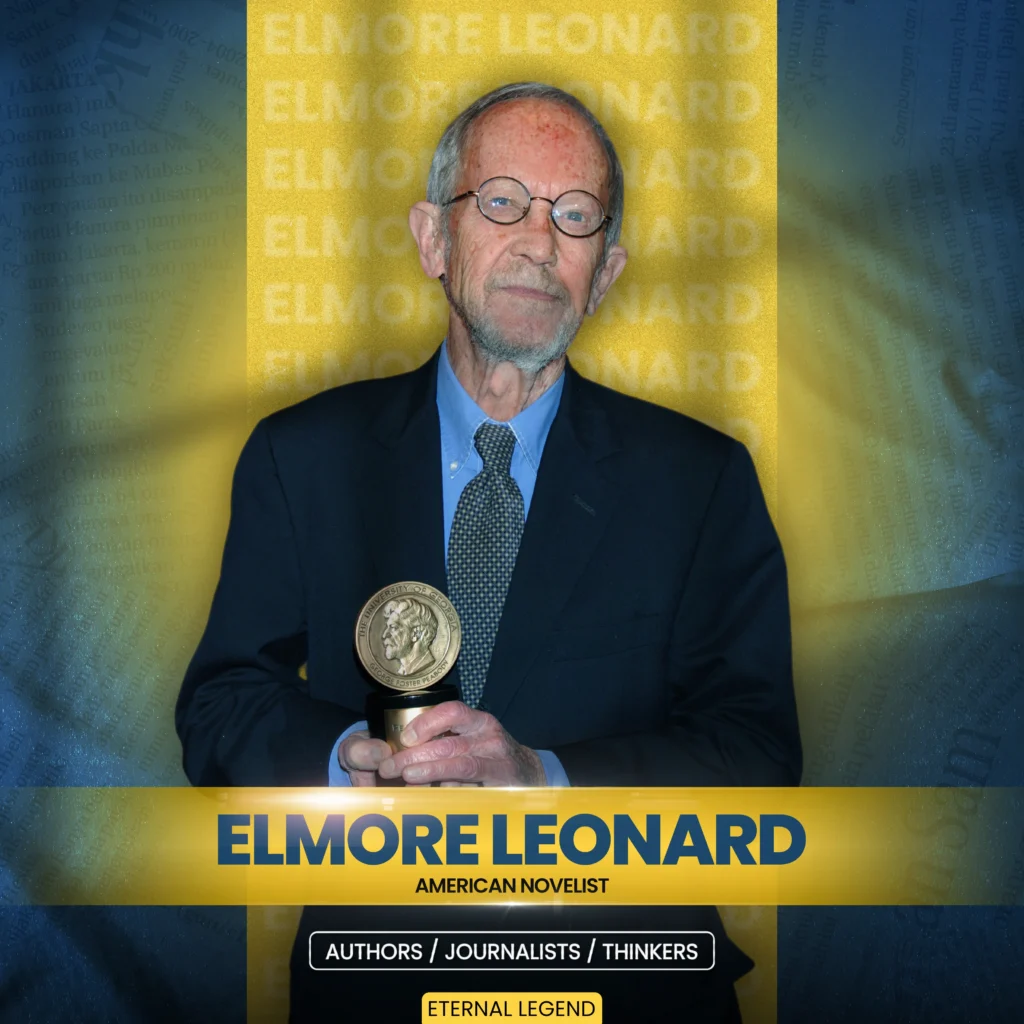
Elmore Leonard: Bard of a Broken City

313 Legends

Elmore Leonard

Eternal Legend

Elmore Leonard: Bard of a Broken City

Born: October 11, 1925 - New Orleans, Louisiana.

Died: August 20, 2013 - Bloomfield Hills, Michigan.

Detroit Era: 1934-2013

Legacy: Writer of 45 novels, screenwriter of dozens of crime classics (Get Shorty, Out of Sight, Jackie Brown), literary giant with razor-sharp dialogue and lean prose who could make Detroit's underworld sing.

Introduction

Legendary author Elmore Leonard wrote like the city he lived in:

No frills. 

All teeth.

Indeed, one doesn’t read Leonard to feel safe – you read him to watch things unravel – because no one can tell a story better than a man who lived and breathed trauma and recovery for nearly 80 years.

From New Orleans to Detroit

Originally from New Orleans, Elmore Leonard moved to Detroit at the age of 9 when his father began working at General Motors. 

This was the height of the Great Depression, and Detroit – a place already ripe with industrial muscle and racial tension – would play a significant role in the man he’d go on to become.

Leonard later served in the Navy during World War II before going on to graduate from the University of Detroit with degrees in Philosophy and History.

In his early days, he made a career out of writing ads for Chevrolet, but by night, he delved into his real passion: fiction. 

Rise of a Great

Leonard started writing as a Western novelist in the 1950s, which saw him penning stories like “Hombre” and “3:10 to Yuma” – the latter of which was made into a Hollywood film not once but twice.

It was only when the Wild West dried up that Leonard turned his attention east toward the gritty streets of Detroit.

It was the 1970s, and the city was cracking under the weight of police corruption, white flight, heroin, auto layoffs, and arson.

Leonard’s reaction?

He refused to paint the city as noble.

Instead, he gave us hustlers, ex-cons, hitmen, and half-smart crooks who thought they had it all figured out (spoiler alert: they never did) as well as dialogue that hit like a jazz riff.

Leonard never described characters.

He let them speak for themselves…and what came out were voices you’d swear you had heard on 7 Mile, Cass Avenue, or in the back of a bail bondsman’s Buick.

His writing rules became legendary:

Leave out that bit that readers skip over.

And when it sounds like writing, rewrite it.

He had tight prose. His wit was dry. And he told stories that moved like a getaway car with a half-flat tire – fast, dangerous, unpredictable.

In Leonard’s work, Detroit became a character in and of itself, not just a location.

Books like City Primeval, Freaky Deaky, Swag, and 52 Pickup are love letters to a city that had been mugged, flipped, and left for dead – yet continued to talk back.

Not only that, but the class tension between Grosse Pointe and 8 Mile were also perfectly captured by Leonard, with Detroit’s suburban sprawl making many of his getaway scenes longer, quieter, and punctuated by pool halls and pawn shops. 

The Day Hollywood Came Calling

Leonard’s work was cinematic long before it found its way to film, and yet, many of his most iconic pieces of work would go on to become box office hits, such as:

  • Get Shorty (1995): A Hollywood satire.
  • Jackie Brown (1997): A love letter to Leonard’s “Rum Punch” by the iconic Quentin Tarantino.
  • Out of Sight (1998): a sleek, sexy, and sharp film starring George Clooney and Jennifer Lopez.
  • Justified (2010-2015): Based on his character Raylan Givens – one of TV’s smartest crime dramas.

In short, Leonard was more than a writer.

He was a genre all of his own.

Transmutation Through the Written Word

Leonard lived most of his adulthood in the Detroit suburbs – specifically Bloomfield Hills, where he wrote daily in longhand on yellow legal pads. 

No assistants. 

No gimmicks. 

Just characters talking in their heads.

He had five children, beat cancer, and worked until his late 80s, with his literary contemporaries calling him the “Dickens of Detroit” when he died in 2013.

The thing is – he’d have hated that.

It was too fancy.

He would have preferred to be called what he was:

A guy who listened.

Who watched.

Who told the truth and nothing but it. 

Final Word on a Literary Great

Elmore Leonard never had to romanticize Detroit.

He understood its music, its menace, its sarcasm.

He gave us criminals with hearts, cops with grudges, and dialogue so sharp it could slice steel.

His characters lived in busted homes, dim bars, pawn shops, precincts, used car lots – anywhere hope was lost and survival required wit.

And through it all, he made one thing clear:

Detroit didn’t need saving.

It needed to be valued for what it already was

About the Author

Victoria Jackson

Victoria Jackson (Editor In Chief)

Victoria Jackson is a lifelong student and sharp-eyed documentarian of all things Detroit, from its rich musical roots and cultural icons to its shifting neighborhoods, storied architecture, and underground legends. With her finger firmly on the pulse of both the city’s vibrant past and its rapidly unfolding future, she brings a deeply personal, historically grounded lens to every piece she writes.

Published on: June 26, 2025