
or

By signing in, I accept the Rebuildetroit.com Terms of Use.

Agent Registration

Find Your Agent Profile

Agent Registration

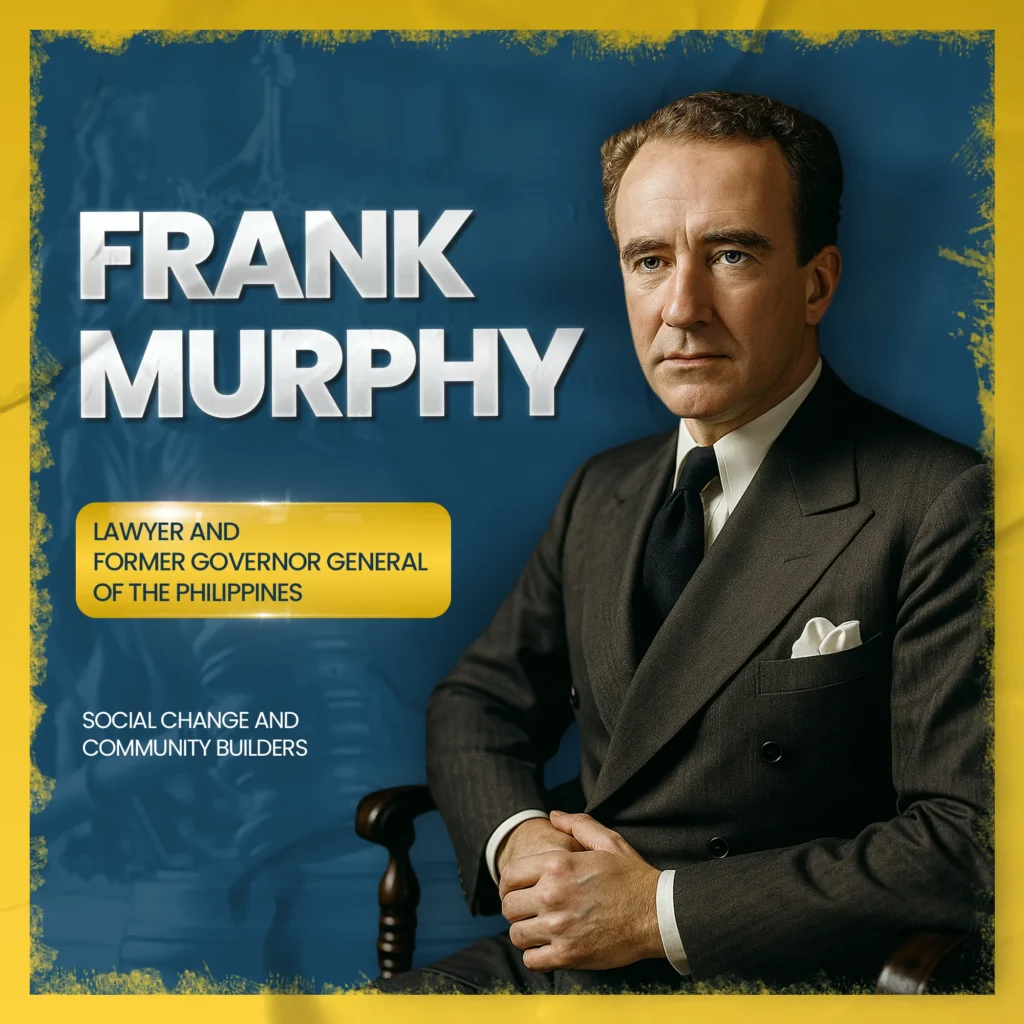
Frank Murphy: Conscience in a Black Robe

313 Legends

Frank Murphy

Eternal Legend

Frank Murphy: Conscience in a Black Robe

Born: April 13, 1890, in Harbor Beach, Michigan

Died: July 19, 1949, in Detroit, Michigan

Detroit Era: 1920s-1930s

Legacy: Former Mayor of Detroit, Governor of Michigan, Governor-General of the Philippines, U.S. Attorney General, U.S. Supreme Court Justice, loyal friend, civil rights champion, and dissenter in the age of silence.

Introduction

Long before he sat under the seal of the Supreme Court or stood alone against internment, Frank Murphy walked the streets of Detroit with his sleeves rolled up and his ears open. 

He was not a politician who hid behind numbers and walls. 

Instead, he saw disenfranchisement for what it was, and he responded by refusing to crush the working class for the comfort of corporations, recognizing that the law could be the cruelest bludgeon if not handled carefully.

When the Great Depression’s darkest winters hit Detroit, Murphy knew poverty was more than just a personal failing – it was a product of systemic neglect.

In response, he opened relief kitchens, housing programs, and emergency aid lines when factories locked their doors and landlords slammed theirs. 

Where others demanded order, he demanded dignity.

For that, the powerful called him dangerous – but Murphy was unmoved.

The approval of the powerful did nothing for him.

His loyalty was with those on the fringes of society.

Life Under Murphy’s Leadership

In 1937, Murphy declined to send in the National Guard when auto workers in Flint sat down and refused to leave the factory – a rebellion against the Ford machine that treated men like parts.

Business leaders howled.

Political allies winced.

Yet Murphy saw something that they didn’t: that strike wasn’t chaos – it was courage.

A means of survival – Not sedition.

Above all else, it was about challenging the law – about writing a new moral code for a labor system built on silent suffering.

Murphy did his part by aligning with the working man not because it was safe – but because it was right.

It was a moral code that would go on to define the entire trajectory of his career.

He served the invisible, and for that, he received nothing in the way of any kind of applause.

That is until the moment Roosevelt called him to Washington. 

Murphy was sworn in on January 2, 1939, in a ceremony at the White House.

A year later, on January 4, 1940, Roosevelt nominated Murphy for the Supreme Court to fill the vacancy left behind by Justice Pierce Butler’s death.

He was confirmed and took his seat as Attorney General in January 1940, later going on to become Associate Justice.

Murphy Does D.C.

During his time in D.C., Murphy took the moral compass he had forged during his time in Detroit to the national stage and never wavered, gaining a reputation for being an ethical dissenter rather than someone that always sided with the majority.

In fact, he was even the first Justice to use the term racism in a Court opinion, and as the nation wrapped itself in a knot and imprisoned more than 120,000 Japanese Americans in camps, Murphy stood alone in Korematsu. 

His words sparked outrage time and time again, yet while other justices merely wrote law, Murphy never feared speaking the truth.

He understood what it meant to dissent amid war hysteria and segregation.

He knew it was going to cost him, yet he refused to back down.

Because for Frank Murphy, justice was not consensus – it was conscience.

End of the Line

The hard path Murphy chose ended when he was 59.

He died in his sleep at Henry Ford Hospital in Detroit on July 19, 1949, of a coronary thrombosis – but his spirit of courage and dissent was never forgotten.

Look no further than Detroit’s Frank Murphy Hall of Justice, also known as the Wayne County Criminal Justice Center, which officially opened on Tuesday, September 3, 2024, nearly 75 years after his death.

For Frank Murphy, law without morality was violence disguised as justice.

He was not a perfect man, yet he was just, and every room he entered changed in temperature.

He was never afraid to ask: “But who does this serve?”

And if the answer was not the voiceless, the broken, or the wounded – he would not attach his name to it.

To walk in his footsteps, one must not chase power – they must seek mercy.

Judge without cruelty.

Protect without spectacle.

Dissent even when the room is silent.

And above all else: leave this world better than you found it – even if you won’t be thanked for it until long after you leave.

About the Author

Victoria Jackson

Victoria Jackson (Editor In Chief)

Victoria Jackson is a lifelong student and sharp-eyed documentarian of all things Detroit, from its rich musical roots and cultural icons to its shifting neighborhoods, storied architecture, and underground legends. With her finger firmly on the pulse of both the city’s vibrant past and its rapidly unfolding future, she brings a deeply personal, historically grounded lens to every piece she writes.

Published on: June 27, 2025