

 Please check your email for your login details.
If Iggy Pop was Detroit’s bare chest provocateur, Fred “Sonic” Smith was its cool hand on the fretboard:
Fierce, innovative, and grounded in working-class authenticity, he didn’t just play rock ’n’ roll…he made it sound as if it was inevitable.

Eternal Legend
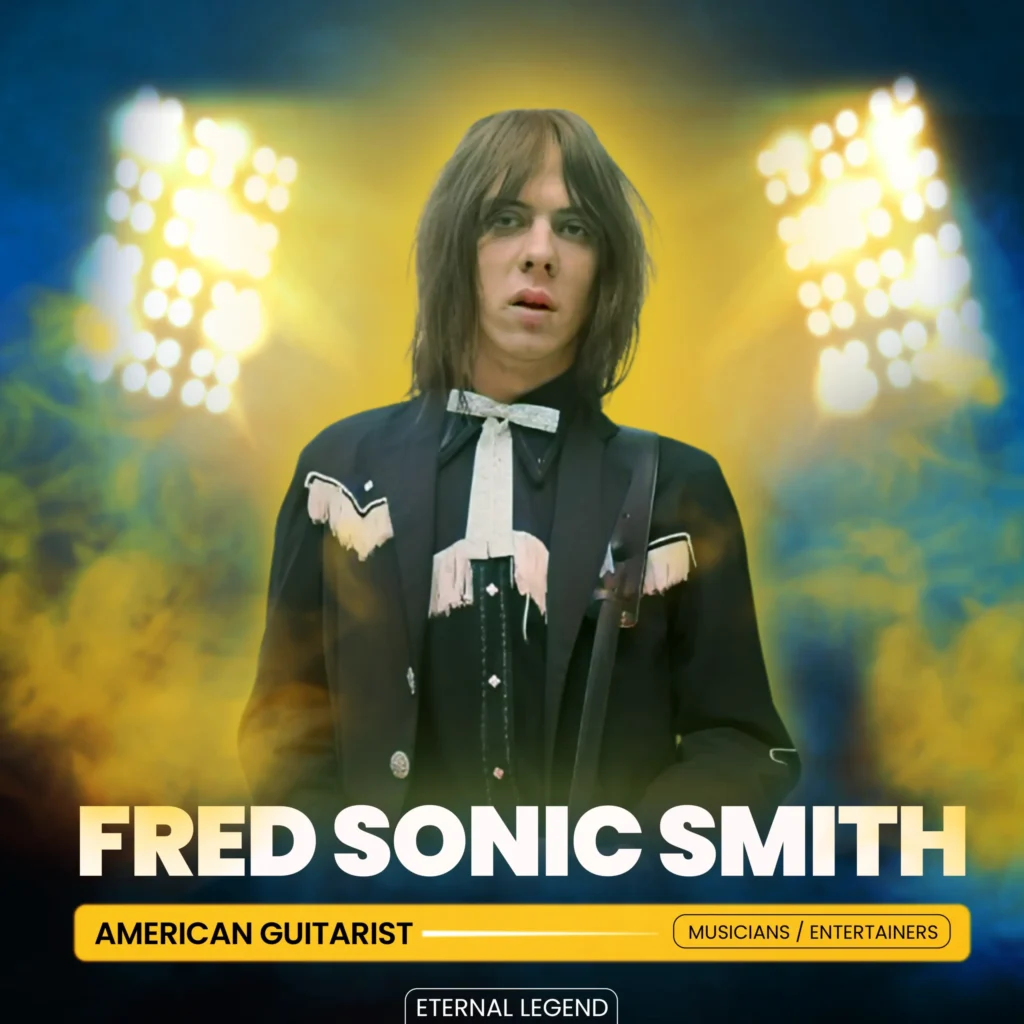
Born: September 14, 1948, Lincoln Park, Michigan
Died: November 4, 1994, Detroit, Michigan
Detroit Era: 1960s–1994
Legacy: Guitarist for the MC5, co-founder of Sonic’s Rendezvous Band, songwriter, and quiet architect of Detroit’s raw, high-voltage rock sound. A figure who helped turn garage rock into a movement, and then chose life, love, and integrity over the machinery of fame.
If Iggy Pop was Detroit’s bare chest provocateur, Fred “Sonic” Smith was its cool hand on the fretboard:
Fierce, innovative, and grounded in working-class authenticity, he didn’t just play rock ’n’ roll…he made it sound as if it was inevitable.
Fred Smith grew up in Lincoln Park, a working-class suburb just south of Detroit known for its manufacturing way of life.
By the mid-1960s, he was performing in local garage bands over the backdrop of Detroit’s bustling auto plants right at a time when the city’s counterculture was just beginning to stir to life.
It all came to a head in 1966, when he became a founding member of the Motor City Five (MC5).
During his time with MC5, Fred brought with him not only a jaw dropping guitar ability, but a rare sense of precision, a good ear, and endless compositional aptitude.
MC5 were not merely a band—they were a political declaration with a yearning to blow the walls off of mainstream societal and musical conventions.
MC5’s debut album “Kick Out the Jams” (1969) was a game changer.
It served as a perfect example of the band’s endurance when it came to performing live.
Smith’s playing was equal parts structure and aggression—sharp riffs, molten solos, and a relentless forward motion that gave the bands chaos form.
MC5’s mix of rock ferocity and radical politics made them heroes to some and unfortunately… targets to others.
FBI surveillance, political controversy, and an inability to translate their live fire into sustained commercial success led to their breakup in 1972.
And yet, in spite of it all, Smith was not yet finished redefining Detroit rock.
In 1974, Smith founded the Sonic Rendezvous Band with Detroit rock veterans Scott Morgan (The Rationals), Gary Rasmussen (The Up), and Machine Gun Thompson (a fellow former MC5 bandmate).
They went on to become a supergroup that was greatly revered in the Midwest yet mostly under the mainstream radar.
“City Slang”, the band’s most well-known track, is pure Fred Smith — tight, propulsive, and unapologetically Detroit.
While Sonic never released a full album during their tenure, their cult status grew over the decades, having a heavy influence on punk and garage revivalists alike.
Fred married the poet and punk icon Patti Smith in 1980, in what became one of the quietest love stories in rock ‘n’ roll history.
The two then stepped out of the public eye altogether to focus on raising their children, Jackson and Jesse.
It wasn’t a retreat for Fred, but instead, a focused decision.
Having lived through the volatility of the music industry, he chose something that was to him much more meaningful: family.
He also wrote several songs for Patti during this time, including “People Have the Power” (1988), which became an anthem of resilience and activism.
Fred “Sonic” Smith died in 1994 at the age of forty-six from congested heart failure.
His death ended the life of a man who shaped the musical fingerprint of early Detroit rock, all while refusing to let the industry define him.
Patti Smith would later return to the stage, carrying Fred’s spirit and influence into her work and often citing him as her greatest muse.
Fred “Sonic” Smith never chased celebrity status.
Instead, he searched for the truth in the music—the perfect riff, the unbreakable groove, the song that could outlast the noise of the moment.
He gave the Detroit rock scene its foundation: militant rhythm, garage grit, and an unpretentious sense of purpose.
Smith represented a rare combination of discipline and rebellion, whether on stage with MC5, in a small club with Sonic’s Rendezvous Band, or writing with Patti at home.
He didn’t just kick out the jams…
He invented a new lane entirely.

Victoria Jackson (Editor In Chief)
Victoria Jackson is a lifelong student and sharp-eyed documentarian of all things Detroit, from its rich musical roots and cultural icons to its shifting neighborhoods, storied architecture, and underground legends. With her finger firmly on the pulse of both the city’s vibrant past and its rapidly unfolding future, she brings a deeply personal, historically grounded lens to every piece she writes.
Published on: August 19, 2025