or

By signing in, I accept the Rebuildetroit.com Terms of Use.

Agent Registration

Find Your Agent Profile

Agent Registration

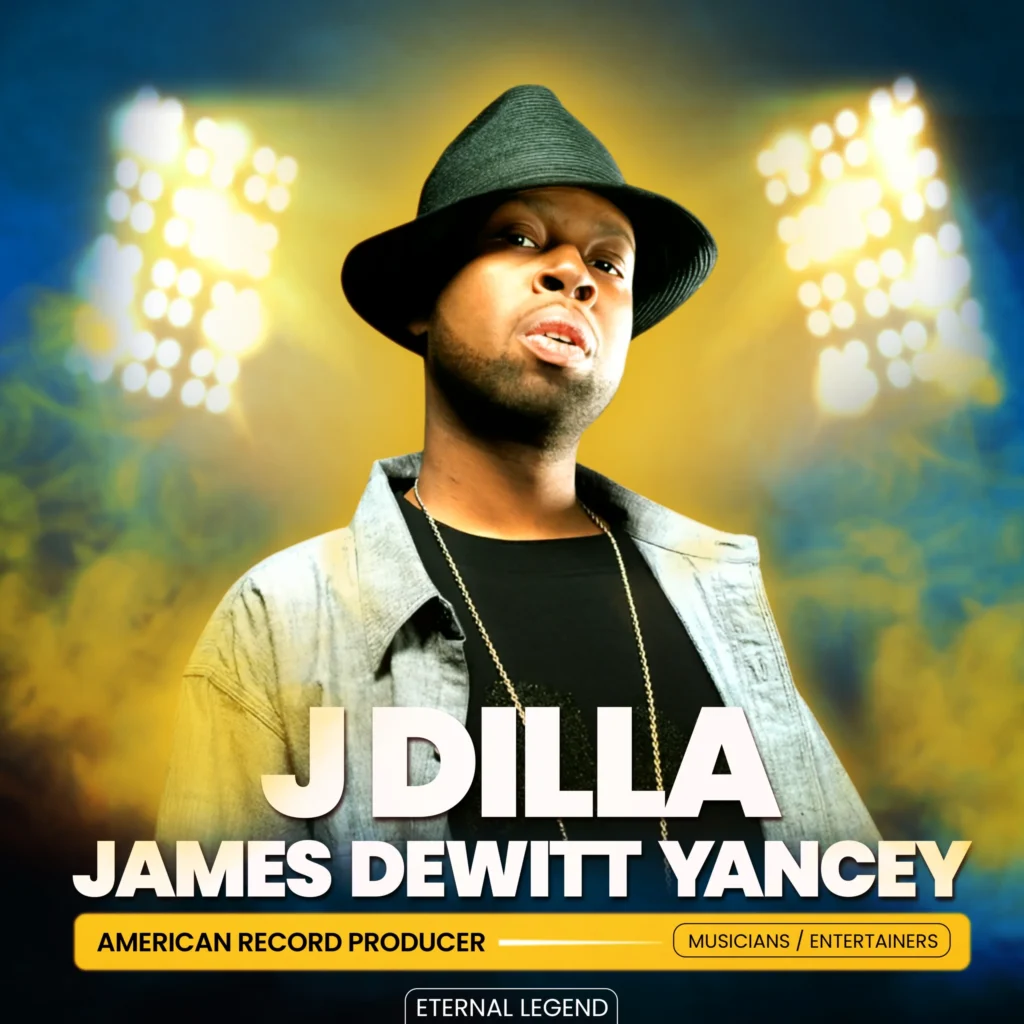
J Dilla: Detroit’s Musical Visionary

313 Legends

J Dilla

Eternal Legend

J Dilla: Detroit’s Musical Visionary

Born: February 7, 1974, in Detroit, Michigan
Died: February 10, 2006, in Los Angeles, California
Detroit Years: 1974-2004
Legacy: Producer, beatmaker, visionary – Detroit's unsung genius who rewired hip-hop from his basement and made imperfection sound divine.

Introduction

Long before Kanye West called him “the god,” and Questlove swore by his drumming, J Dilla was James Dewitt Yancey from Conant Gardens, Detroit – a shy, meticulous kid who made crafting beats and records look easy.

He never chased fame.

He chased feeling.

He didn’t merely sample songs – he channeled spirits.

Listen to a Dilla beat, and you’ll hear more than just rhythm.

You’ll hear the soul being cracked open and rearranged.

Born in the Garden

J Dilla was born in Detroit on February 7, 1974, and raised in Conant Gardens, a historic Black neighborhood on Detroit’s east side.

His father, Beverly Dewitt Yancey, was a jazz bassist, and his mother, Maureen “Dukes” Yancey, was a singer and educator.

It made for a household where music was a language – one spoken fluently and reverently –with greats like Roy Ayers, Marvin Gaye, Stevie Wonder, and Herbie Hancock just as emblematic of Dilla’s childhood as the city sounds outside.

It was the kind of upbringing that led to Dilla knowing how to spin records before he even knew how to ride a bike, with his love of music further evolving when he was a teenager at Detroit Pershing High School and formed the iconic rap group “Slum Village” with his close friends T3 and Baatin.

Dilla wasn’t just rapping.

He was chasing feeling.

Basement Alchemy

As the East Coast and West Coast fought for hip-hop supremacy in the early 1990s, Dilla was making history right from his own Detroit basement.

Armed with an Akai MPC3000, a tape deck, and a crate of squeaky-clean vinyl, he started chopping up loops, layering off-beat drums, and sampling vocals no one else even thought to flip.

What came out wasn’t perfect – and that’s exactly what made it so transcendent.

Dilla’s beats breathed.

They stuttered.

They wept.

It was a machine sound – one built on rhythm and repetition – but Dilla bent that rhythm just enough to make it feel human again.

And in no time, word spread.

The Underground Come up

By the mid-1990s, Dilla’s sound was leaking outside Detroit.

A copy of one of his beat tapes ended up in the hands of Q-Tip from a Tribe Called Quest, who brought Dilla on board with what they were doing, first as a sidekick, then as part of the Ummah production team along with Ali Shaheed Muhammad and Q-Tip himself.

Just like that, J Dilla was everywhere – yet nowhere – embossing classic records without ever placing his name directly on them.

His fingerprints appear on:

A Tribe Called Quest: “Beats, Rhymes, and Life”

De La Soul: “Stakes are High”

Busta Rhymes: “Woo Hah Mixer”

The Roots: “Things Fall Apart”

He also helped power up the Soul Quaker movement, infusing neo-soul, black artistry, and a return to feeling over formulas, always with Detroit remaining central in it all.

Slum Village

Although he now produced for legends, Dilla still made the time to manage his band Slum Village, whose 2000 album “Fantastic Vol. 2” was considered Detroit scripture: raw, funny, soulful, and fiercely local.

It sounded like Motown passed through a Dilla filter: chopped, screwed, and reassembled with reverence.

That album was not certified platinum, but it didn’t need to be.

It still solidified J Dilla as the leader of a new Detroit sound: bluesy, weird, syncopated, spiritual, and absolutely unique, birthing a new generation of greats like Madlib, Flying Lotus, 9th Wonder, and even Kanye – all of whom started uttering Dilla’s name with the same kind of reverence they had for Miles Davis and Coltrane.

Donuts and the Day That Changed Everything

In 2003, tragedy struck when Dilla was diagnosed with lupus and a rare blood disease, which quickly led to him beginning to lose control of his body.

He moved to Los Angeles in 2005 for health reasons, and that would be where he’d complete his final work, “Donuts”, a 31-track fever dream of chopped soul loops, gospel howls, disembodied drums, and aching joy, all of which was mostly recorded from a hospital bed.

It was released on his 32nd birthday on February 7, 2006 – a love letter to sound, a goodbye note, and a reproach of death itself.

Dilla passed away three days later, and just like that…Donuts wasn’t just an album.

From street DJs to symphony composers – it became a sacred text, a farewell anthem that would be studied, mourned, and celebrated by all for decades to come.

J Dilla’s Lasting Legacy

The legend of Dilla only grew bigger after his death.

In the 2022 documentary on Dilla, Dillatime, Questlove famously said,

“Explaining musical genius is my mission. To be able to tell the world about the musician who had the most influence on me is a dream come true. Not just on me, but on an entire generation of musicians that everyone knows and loves. J Dilla was our teacher. And what he taught us was how to feel rhythm in a way we had never felt before.”

It was a sentiment shared by greats like Kanye, who has repeatedly credited Dilla as one of the main forces that forever changed hip hop, and lesser-known music icons like Flying Lotus, who said that Donuts was the main reason he started making music.

In Detroit, murals were erected.

Tribute shows multiplied.

February 7th became Dilla Day.

And his mother Maureen, “Ma Dukes”, even started the J Dilla Foundation for music education and lupus awareness.

The Eternal Loop

Dilla’s MPC 3000 is housed in the Smithsonian’s National Museum of African American History and Culture – a little piece of Detroit history that wouldn’t have been possible had J Dilla never existed.

Radio plays never mattered to him.

He chased truth.

He turned samples into sermons.

He made hip-hop strange again.

Sacred again.

He was not a man who wanted to be famous.

He wanted to touch something… and make you feel it as well.

He was jazz without the solos.

Soul without a safety net.

Gospel without the choir robes.

And he did it all while sitting in the basement of a poor Detroit home, rewiring the world over pads and buttons.

Today, his spirit can still be felt everywhere.

In every beat.

In every loop.

In every young producer dragging a sample through the dirt looking for gold.

And even though he left this earth in 2006, he still has a lasting impact on Detroit…

Not to mention the music industry he forever changed.

About the Author

Victoria Jackson

Victoria Jackson (Editor In Chief)

Victoria Jackson is a lifelong student and sharp-eyed documentarian of all things Detroit, from its rich musical roots and cultural icons to its shifting neighborhoods, storied architecture, and underground legends. With her finger firmly on the pulse of both the city’s vibrant past and its rapidly unfolding future, she brings a deeply personal, historically grounded lens to every piece she writes.

Published on: August 18, 2025