
or

By signing in, I accept the Rebuildetroit.com Terms of Use.

Agent Registration

Find Your Agent Profile

Agent Registration

Paul Chambers: Detroit’s Bass Virtuoso

313 Legends

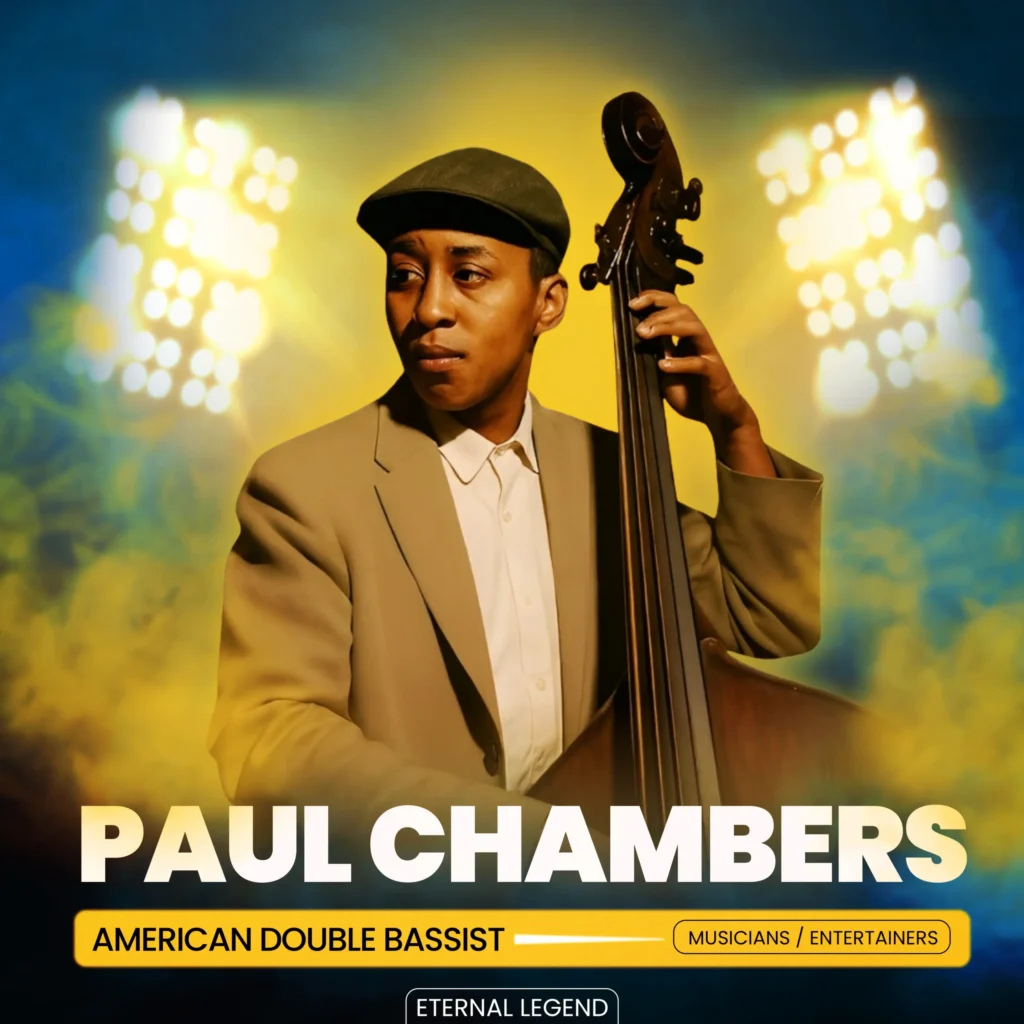
Paul Chambers

Eternal Legend

Paul Chambers: Detroit’s Bass Virtuoso

Born: April 22, 1935, Pittsburgh, Pennsylvania
Died: January 4, 1969, New York City
Detroit Era: 1940s–1954 (formative years)
Legacy: Jazz double bassist whose work with the Miles Davis Quintet and numerous recordings made him one of the most influential bassists in modern jazz. A product of Detroit’s fertile post-war music scene, Chambers combined classical training with deep swing, shaping the language of the instrument for generations.

Introduction

Backed by perfect timing and melodic inventiveness, Paul Chambers was a man whose sound anchored an enormous volume of iconic records — a feat he could not have accomplished had it not been for his upbringing growing up in Detroit, which gave him both the technical base and the rhythmic edge that would later go on to become his trademark.

Chambers was born in Pittsburgh but moved to Detroit as a young child with his family, a community with a music education system and jazz scene that was among the best in the nation at the time.

At Cass Technical High School, he studied classical bass and developed sight-reading and bowing abilities that would later distinguish him in jazz.

Chambers then began performing in Detroit clubs as a teenager alongside local heavyweights like Kenny Burrell, Yusef Lateef, and Barry Harris at a time when the post-war jazz scene in the city was extremely competitive, forcing young players to learn bebop and the high standards that club audiences demanded.

A Breakthrough in New York

Chambers left for New York in 1954, where his versatility and maturity soon attracted interest.

He joined Miles Davis’ First Great Quintet in 1955 and then went on to play with John Coltrane, Red Garland, and Philly Joe Jones.

Chambers’ warm tone, perfect intonation, and inventive walking lines anchored the group harmoniously and rhythmically.

He recorded multiple albums at this time, including “Round About Midnight” (1957), “Milestones” (1958), and “Kind of Blue” (1959), with the latter being his best-selling jazz record ever.

In fact, one of jazz’s most famous moments is Chambers’ arco-bass introduction to “So What.”

Miles Beyond Miles

Chambers became one of the most recorded bassists in jazz history under Davis.

He worked with Cannonball Adderley, Hank Mobley, Sonny Rollins, and many more, and with his adaptability, he could play hard bop, modal jazz, or even swing conventions.

Eventually, he even started leading some sessions under his own name, including a bass solo (1957), where he showed that he could play the bass like a lead singer without losing his groove.

In short, the Detroit influence is evident in his sound.

In each performance, Chambers infused Detroit’s signature sound with his own musical DNA, building on solid fundamentals influenced by the city’s blues and gospel undertones in an environment where precision and individuality were equally valued.

The Last Word: Bass as Conversation

Paul Chambers made the double bass what it is today.

His lines did not just accompany the soloists above them; they moved in perfect sync right alongside them.

On each note, you can hear Detroit at its finest: disciplined, soulful, and never afraid to swing.

Although tuberculosis led to Chambers’ untimely passing at the young age of 33, his voice can still be heard on thousands of recordings that have taught and inspired an entirely new generation of musicians.

For that, his legacy will live on in the hearts of jazz loving Detroiters for decades to come.

About the Author

Victoria Jackson

Victoria Jackson (Editor In Chief)

Victoria Jackson is a lifelong student and sharp-eyed documentarian of all things Detroit, from its rich musical roots and cultural icons to its shifting neighborhoods, storied architecture, and underground legends. With her finger firmly on the pulse of both the city’s vibrant past and its rapidly unfolding future, she brings a deeply personal, historically grounded lens to every piece she writes.

Published on: August 19, 2025