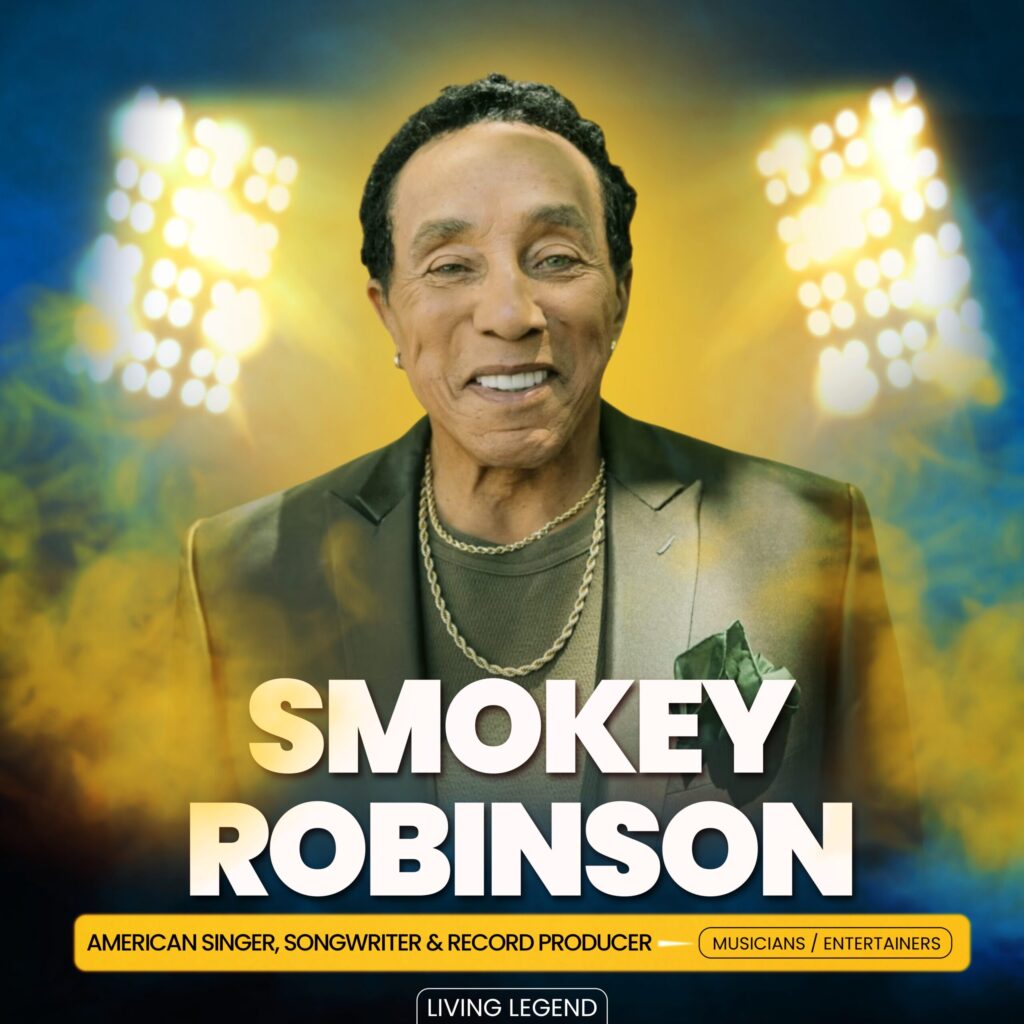
But Smokey had demons behind his legendary smile and perfect phrasing.
He fought cocaine addiction in the 1980s and almost lost his marriage and health in the face of it.
It was only divine intervention that finally pulled him out, he’d later say, not rehab.
And like any great poet, he didn’t cover the scars – he shared them to help others see the order in the chaos.
Smokey’s 1989 autobiography was as honest as it was eloquent.
He didn’t air out all his dirty laundry – but he also didn’t sanitize the truth.
In the decades since then, Smokey Robinson has remained a musical and cultural treasure.
A member of the Rock & Roll Hall of Fame (1987) and a Grammy Lifetime Achievement Award winner, he’s been honored by everyone from presidents to a new generation of creators such as Anderson Paak, an award-winning artist Smokey has worked closely with.
Still working even at the age of 83, Smokey released “Gasms” in 2023, reminding fans that he’s still the same playful, flirty, fearless man he was in his heyday.
That said, Smokey’s greatest legacy isn’t necessarily his voice.
It’s his gift for writing.
It’s the lines that we all know by heart – the ones that make us weep in traffic or dance in the kitchen – all backed by the spirit of a city that knew joy and pain in equal measure.
No one ever truly leaves Detroit – Smokey Robinson included.
When Smokey left for Los Angeles, his sound – and his soul – remained stitched into the city’s fabric.
It was a place that had taught him that softness can be strong, that heartbreaks can be poetry, and that a battered and broken city can sing love songs with its chest out and its eyes closed.
He isn’t loud, but he doesn’t have to be.
He’s Smokey.
That’s enough.



 Please check your email for your login details.