or

By signing in, I accept the Rebuildetroit.com Terms of Use.

Agent Registration

Find Your Agent Profile

Agent Registration

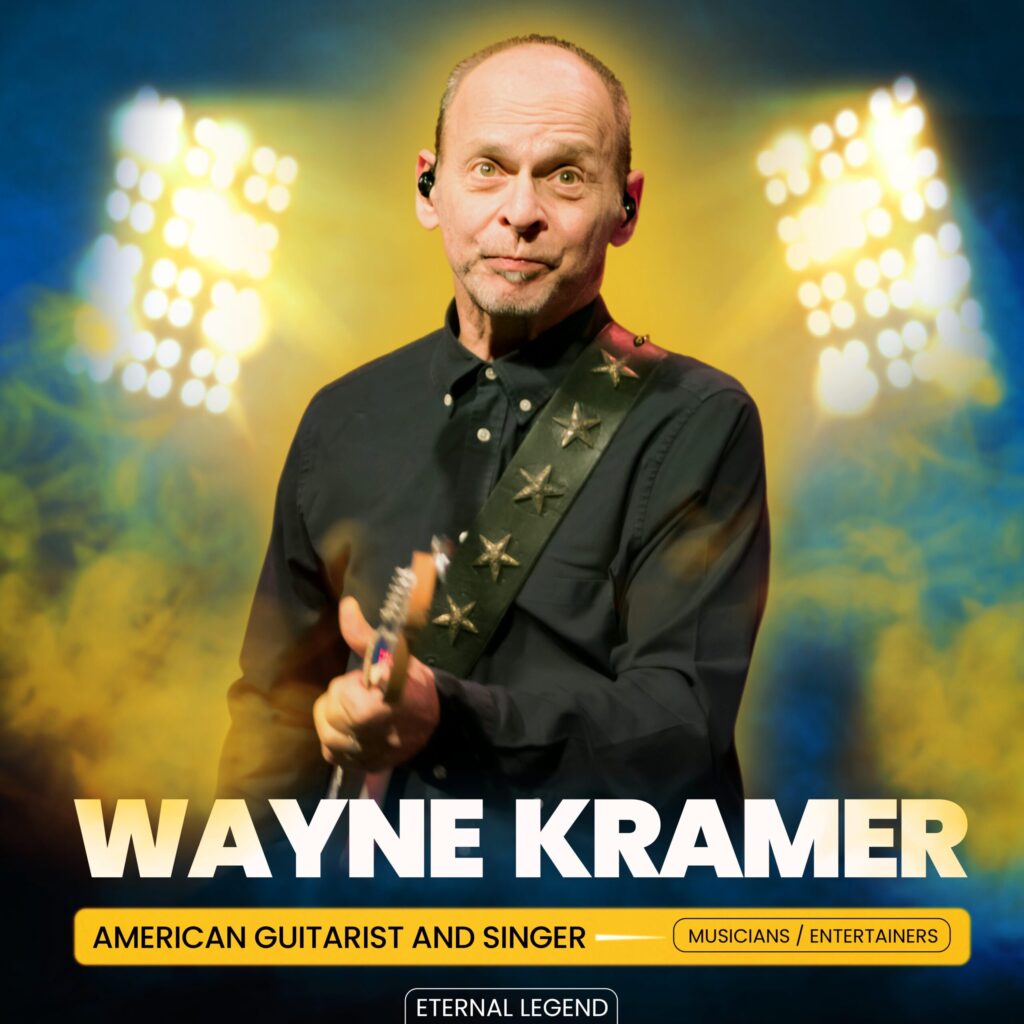
Wayne Kramer: Detroit’s Iconic Revolutionary

313 Legends

Wayne Kramer

Eternal Legend

Wayne Kramer: Detroit’s Iconic Revolutionary

Born: April 30, 1948, in Detroit, Michigan

Died: February 2, 2024, in Los Angeles, California

Detroit Years: 1948-1975 (forever in spirit)

Legacy: Guitarist, activist, ex-con, and co-founder of the MC5. the Motor City's loudest and most politically explosive rock band.

Introduction

When punk lacked a name, before rock had fangs, and before rebellion was commoditized, Wayne Kramer stood shirtless on a Detroit stage with a white Stratocaster in hand ripping holes in the American dream with every distorted chord he played.

He did not want approval. 

All he needed was your attention.

If Detroit itself was known for building cars, Wayne was born to set the factory on fire and make music out of the ashes.

East Side Speed Freak Blues

Born in 1948 on Detroit’s east side, Wayne Kramer grew up during the city’s post-war boom in a working-class household that valued conformity, obedience, and the Ford factory line – the polar opposite of Wayne’s curious, impulsive, wild temperament. 

His love of blues came first, then jazz, then greats like Little Richard, Chuck Berry, and John Coltrane. 

However, Wayne wanted to play the licks himself…and detonate them.

It was a yearning that led to him picking up a guitar come his teen years and never looking back. 

He joined high school friend Fred “Sonic” Smith, Rob Tyner, Dennis Thompson and Michael Davis in 1964, creating the iconic Motor City Five. 

Their sound?

One-part garage rock, one-part soul riot, one-part Molotov cocktail – a sound that would go on to become signature to Detroit.

Greatness Rooted in Fury

MC5 quickly became Detroit legends with their electrifying live shows, political fury, and unapologetic volume.

The band played at anti-war rallies, leftist gatherings, and even Black Panther Party events.

Managed by radical poet John Sinclair, the MC5 was inciting insurrection.

They played at the infamous 1968 protest outside the Democratic National Convention in Chicago – the only band to show up when the city became a battlefield.

They also put the chaos in a bottle with their 1969 debut album “Kick Out the Jams”. That title track – which opened with Tyner’s now-iconic scream – “Kick out the jams, motherfucker!” – was more than a lyric.

It was a manifesto.

One that divided critics and terrified the establishment. 

Hudson’s Department Store in Detroit even went as far as pulling the album off the shelves, which led to MC5 running an ad telling Hudson’s to “f*** themselves.”

In short, Wayne was not just playing guitar. 

He was utterly shredding the concept of obedience – one lick at a time.

The Fall and Bust

That said, revolution cannot be monetized.

MC5’s second album, “Back in the USA” (1970), stripped down their sound but lost the fire, while “High Time” (1971) was a critical return to form but a commercial failure.

Add in drug use, FBI surveillance, internal fights, and industry blacklisting and the band was all but dead by 1972, leaving the wildest of them all – Wayne Kramer – to spiral into addiction.

Kramer infamously sold cocaine to an undercover officer in Detroit in 1975, receiving four years in federal prison at Lexington, Kentucky – where he met jazz legend Red Rodney, a former Charlie Parker collaborator also serving time.

Reinvention and Resurrection

Surprisingly, Prison actually straightened Wayne up.

After his release in the late 1970s, he set his sights on rebuilding, heading to New York and then to Los Angeles, where he had brief stints playing with Johnny Thunders of the New York Dolls and the band Was (Not Was). 

There was no denying it: Wayne was in a league of his own when it came to talent, yet his legacy was still marked by demons like addiction, PTSD, and broken trust.

Then came the 90s resurgence.

Wayne got clean and signed with Epitaph Records, going on to release “The Hard Stuff” (1995) and “Dangerous Madness” (1996). His guitar playing was sharper than ever – brutal, beautiful, defiant.

Critics and fans finally caught up to what MC5 had always been: a spectacle. 

Prophets of earlier times.

Just like that, Wayne became the spiritual godfather of the punk and garage rock revival, with bands like Rage Against The Machine, The Stooges, The White Stripes, and the Hives citing him as a major influence.

Another Detroit legend, Jack White, even once famously said that Kramer, “taught Detroit musicians that you could rip it up, scream your truth and not ask for permission.” (paraphrase)


More Than a Guitar

Kramer founded Jail Guitar Doors USA in 2009, the nonprofit named after the Clash song and a reference to Wayne’s prison stint. 

The nonprofit provides instruments and programs for inmates, allowing them to channel their pain and trauma into art instead of violence.

This served as Wayne’s big full circle moment.

He believed in rehabilitation through sound, and he showed up at prisons year after year to prove it, becoming a proponent of criminal justice reform, artist rights, and punk values of truth, service and dissent.

In short, Wayne Kramer did more than merely survive the system.

He pulled it apart, riff by riff.

Wayne’s Final Years

Even in his 70s, Wayne never stopped moving, opening for MC50, the 50th anniversary tour of Kick Out the Jams with Soundgarden, Faith No More, and Fugazi. 

Wayne then followed up in 2018 with his memoir “The Hard Stuff: Dope, Crime, the MC5, and My Life of Impossibilities”, a brutal portrait of Detroit that touched on addiction, revolution, and resilience.

It was only after that, on February 2, 2024, that the powerhouse that was Wayne Kramer finally died, succumbing to late-stage pancreatic cancer.

Just like that, the city lost one of its loudest voices.

Legacy: Detroit's Unfiltered Prophet

Wayne Kramer did not do chart music. 

He created for the fired assembly line worker, the radical with a notebook of lyrics, the teen deemed to have no future beyond a busted amp.

Through that, he showed the world that Detroit wasn’t all about soul and cars.

That it was also about noise as truth, feedback as prayer, and art as a revolt.

He was a punk before punk, hip-hop in spirit, and always louder than permission allowed.

It’s the kind of legacy that leaves its mark…and Detroit has never forgotten.

About the Author

Victoria Jackson

Victoria Jackson (Editor In Chief)

Victoria Jackson is a lifelong student and sharp-eyed documentarian of all things Detroit, from its rich musical roots and cultural icons to its shifting neighborhoods, storied architecture, and underground legends. With her finger firmly on the pulse of both the city’s vibrant past and its rapidly unfolding future, she brings a deeply personal, historically grounded lens to every piece she writes.

Published on: July 25, 2025