or

By signing in, I accept the Rebuildetroit.com Terms of Use.

Agent Registration

Find Your Agent Profile

Agent Registration

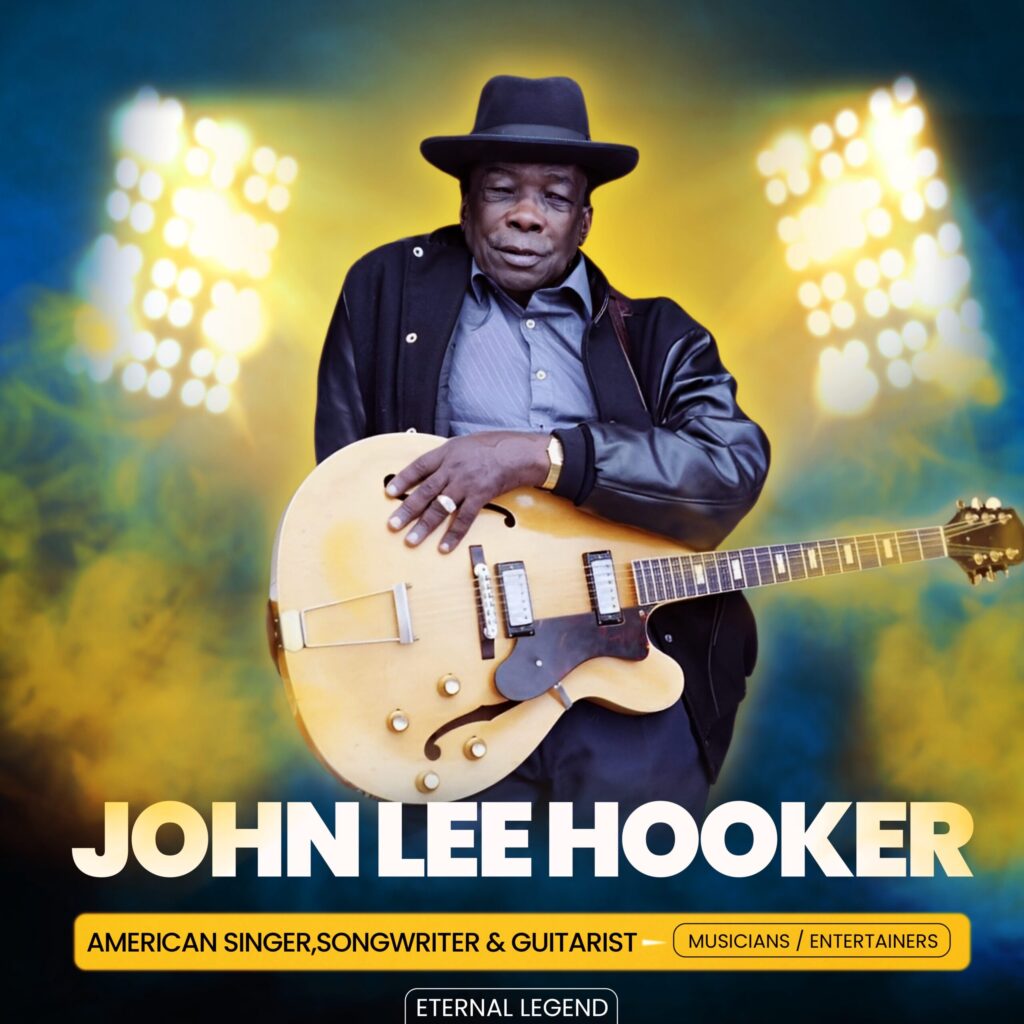
John Lee Hooker: Detroit’s Boogie Man

313 Legends

John Lee Hooker

Eternal Legend

John Lee Hooker: Detroit’s Boogie Man

Born: August 22, 1917, Clarksdale, Mississippi - sources vary

Died: June 21, 2001, Los Altos, California

Detroit Years: 1973-1970s (but spiritually, forever)

Legacy: The blues legend and electric boogie king that brought Delta soul to the concrete grit of Detroit.

Introduction

If Motown was Detroit’s polish, John Lee Hooker was the rust – the slow burn, the hard stomp, the backroom moan. 

While Berry Gordy was putting soul into a tuxedo, Hooker was on Hastings Street plugging his guitar into a beat amp and ripping holes in the air with a low-slurring voice to match.

He did not sing for the prettiest reasons.

He sang to survive.

To conjure.

To hex.

And when he came to Detroit, that voice found its amplifier – not in glitz or gospel, but in the industrial throb of a city that was making something out of nothing.

The Man Born with Blues in His Blood

John Lee Hooker was born in the deep South in Clarksdale, Mississippi, also known as the blues capital.

He was the son of a sharecropper and a Baptist preacher who took in spirituality on Sundays and bootleg blues on Saturdays, with his stepfather, Will Moore, later introducing him to the guitar and the Delta blues that would define his youth.

That said, Hooker was not formally educated. 

He never read music.

What he had instead was an ear for greatness and a razor sharp intuition, two things no school could teach.

Detroit and the Boogie Beat

Hooker joined other Black Southerners heading north in the Great Migration in the late 1930s and arrived in Detroit in 1943.

He came with a suitcase, a guitar, and the blues buried so deep in his bones it was as if he had swallowed it.

The 1940s saw a boom of factories sprout up in Detroit alongside jazz clubs, working men, and weary saints, and Hooker took advantage by working at the Ford Motor Company by day and playing house parties, rental halls, and juke joints on the east side by night.

He was broke, hungry, and on fire, a combination that would lead to his sound developing very quickly: electric, hypnotic, and often based on one chord that pounded on like a heartbeat.

Unlike the straight twelve-bar blues, Hooker played loose, primal, trance-like.

Things got especially promising, however, when he recorded “Boogie Chillen” on a borrowed guitar in a Detroit studio for Sensational Records in 1948.

It went to number one on the R&B charts and sold over a million copies. 

It was raw, minimal, and unlike anything else on the radio – and just like that, a quiet Mississippi man became Detroit’s working-class bluesman.


The Original Lo-Fi Legend

During the 1950s and 1960s, John Lee Hooker recorded under various aliases, including John Lee Booker, Texas Slim, Delta John, and Little Pork Chops, a move caused by contractual chaos and the need to pay rent.

But whatever the name, his sound was distinctive, with songs like:

“Crawlin’ King Snake”

“Hobo Blues”

“I’m in a Mood”

And “Boom Boom”

Coming across more like incantations than musical numbers.

Slowly, the world was beginning to realize:

John Lee Hooker was no crooner.

He was a conjurer.

In a city obsessed with modernity, Hooker stomped the floor and distorted the Delta blues into something else entirely.

Enter Motown

As Motown further developed, Hooker’s ragged blues grew out of synch with Detroit’s sleek musical machine.

He never quite fit the mold – yet he also didn’t try to.

As the Supremes sang about love and heartbreak in beautiful gowns, Hooker was singing about lust, loneliness, and life lived on the edge – songs for people who worked double shifts and came home to an empty bottle and a broken heart.

But all hope was not lost.

When blues exploded across Europe in the 1960s and 1970s, bringing up titans like The Rolling Stones, Eric Clapton, and the Doors, Hooker was finally able to become a global icon without losing his local edge.

He recorded with Canned Heat. He jammed with Van Morrison. He was worshipped by Bonnie Raitt. And yet – he still sounded like that man on Hastings Street, telling stories into a tin can microphone.

Later Years & Honors

Hooker didn’t receive mainstream recognition until the 1980s and 1990s.

Inducted into the Rock and Roll Hall of Fame in 1991, he won four Grammy Awards followed by a Grammy Lifetime Achievement Award in 2000.

Not only that, but later albums of his like “The Healer” (1989), “Mr. Lucky” (1991), and “Chill Out” (1995) paired Hooker with plenty in the way of famous admirers right at a time when Detroit was on the precipice of major change. 

Clubs had closed.

Streets were crumbling.

Yet through it all, Hooker’s voice still rang out from car radios and old jukeboxes, embedding itself in the memories of all who remembered his glory years. 

The Legacy of a Detroit Prophet

Hooker died in 2001 at the age of 83 while living in California, yet his spirit – and his sound – were always distinctly Detroit.

More than a bluesman, John Lee Hooker never sang about polished heartbreak. 

He sang about rough survival as it was: sweaty, sorrowful. 

He never needed choirs or horns or strings. 

Just a foot stomp, a guitar lick, and a deep voice that felt like time traveling.

About the Author

Victoria Jackson

Victoria Jackson (Editor In Chief)

Victoria Jackson is a lifelong student and sharp-eyed documentarian of all things Detroit, from its rich musical roots and cultural icons to its shifting neighborhoods, storied architecture, and underground legends. With her finger firmly on the pulse of both the city’s vibrant past and its rapidly unfolding future, she brings a deeply personal, historically grounded lens to every piece she writes.

Published on: July 25, 2025