or

By signing in, I accept the Rebuildetroit.com Terms of Use.

Agent Registration

Find Your Agent Profile

Agent Registration

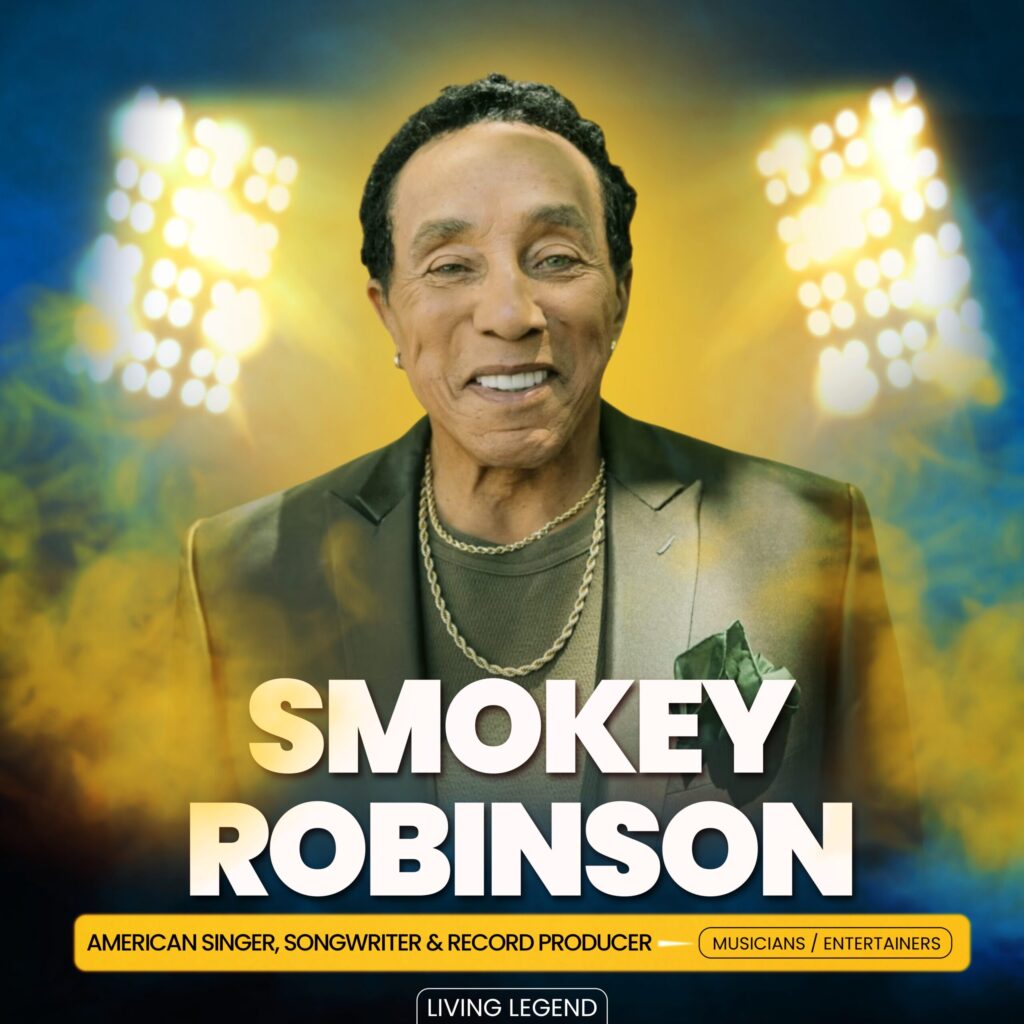
Smokey Robinson: Motown’s Poet Laureate

313 Legends

Smokey Robinson

Living Legend

Smokey Robinson: Motown’s Poet Laureate

Born: February 19, 1940, in Detroit, Michigan

Detroit Years: 1940-1988 (with ongoing influence from Motown and legacy projects)

Legacy: singer/songwriter, producer, and co-architect of Motown Records. Bob Dylan referred to him as "America's greatest living poet."

Introduction

Before he became the velvety voice of endless love songs and transformed a little house on Grand Boulevard into a birthplace of soul, Smokey Robinson was just a skinny kid from Detroit’s North End writing lyrics on notebook paper and dreaming of making music that the world couldn’t ignore.

His voice flowed like honey.

But his pen?

Razor-sharp.

If Berry Gordy built the Motown machine, Smokey was its oil – a longing lyricist, equal parts tender and streetwise – a man who made heartbreak sound beautiful and Detroit’s blue-collar grit universally loved.

Detroit Beginnings: Doo-Wop and Destiny

William Smokey Robinson Jr. was born and raised in Detroit in a modest home on Belmont Avenue.

His Uncle Claude nicknamed him “Smokey Joe,” and the name stuck because of his childhood love of cowboy movies.

Growing up, he listened to Nolan Strong, Hank Ballard, Sam Cooke, and doo-wop groups on crackling AM radios and neighborhood front porches, going on to form a vocal group in high school called The Five Chimes, then later The Matadors, and finally, The Miracles.

He attended Northern High School, where he met the iconic Berry Gordy, and in 1957 The Miracles auditioned for record executive Jackie Wilson.

Wilson passed, yet Berry Gordy stuck around, and from that moment onward…the music industry was forever changed.

The Birth of Motown – and the Soul of it

Berry Gordy recognized something brilliant in Smokey – his lyrics, his arrangements, his drive. 

He helped the Miracles produce their first single, and in turn, Smokey introduced Gordy to the local talent pool that would become Motown’s first wave of stars.

That said, the first and brightest star of Motown Records was Smokey Robinson himself in 1959, a time when he was writing for everyone – not just The Miracles.

In 1960, “Shop Around” became Motown’s first million-dollar single, and from there hit after hit started pouring out at rapid-fire speed:

“You Really Got a Hold on Me”

“Ooo Baby Baby”

“The Tracks of My Tears”

“The Tears of a Clown”

“I’m Second That Emotion”

All are the kind of songs that give you goosebumps. 

As Motown’s in-house songwriter and vice president, Smokey Robinson also wrote and produced hits for:

The Temptations (“My Girl” and “The Way You Do Things You Do”)

Mary Wells (“My Guy”)

Marvin Gaye (“Ain’t That Peculiar”)

The Marvelettes (“Don’t Mess With Bill”)

He was not just writing love songs. 

He was defining Detroit’s signature sound – clean, clever, catchy, and emotional without being depressing. 

Love, Fame, and Miracles

Smokey and the Miracles served as Motown torchbearers during the 1960s, maintaining both local and international fame.

Yet through it all, Smokey always remained loyal to Detroit. 

He even married fellow “The Miracles” member and Detroit local, Claudette Rogers, in 1959, and the two became a musical power couple largely insulated from tabloid drama.

Together, their harmonies were flawless, but by the early 1970s Smokey was being pushed into various new roles that demanded he stand on his own: father, executive, and solo artist.

This led to him leaving The Miracles in 1972, going on to become Motown vice president and a renowned solo performer.

And though he was later replaced by Billy Griffin, the group never quite recovered without Smokey’s golden touch.

Smokey’s Solo Years

In 1975, Smokey released “Quiet Storm,” an album so smooth it launched a whole radio format. Paired with “Baby That’s Backatcha” and “The Agony and The Ecstasy,” the title track became a template for late-night soul and slow jams worldwide.

Smokey was not ripping up the charts like Stevie or Marvin, but he was always elegant – a gentle elder in the Motown pantheon, with tracks like “Cruisin'” (1979) and “Being with You” (1981) reminding the world that he could still command a room with a whisper.

He was at Motown until 1988 and helped the label survive the pop-dominated 80s before stepping away from the business end of music when Berry Gordy sold Motown to MCA that same year – gracefully, as always.

Behind the Scenes Struggles & Lasting Legacy

But Smokey had demons behind his legendary smile and perfect phrasing. 

He fought cocaine addiction in the 1980s and almost lost his marriage and health in the face of it.

It was only divine intervention that finally pulled him out, he’d later say, not rehab.

And like any great poet, he didn’t cover the scars – he shared them to help others see the order in the chaos.

Smokey’s 1989 autobiography was as honest as it was eloquent.

He didn’t air out all his dirty laundry – but he also didn’t sanitize the truth.

In the decades since then, Smokey Robinson has remained a musical and cultural treasure. 

A member of the Rock & Roll Hall of Fame (1987) and a Grammy Lifetime Achievement Award winner, he’s been honored by everyone from presidents to a new generation of creators such as Anderson Paak, an award-winning artist Smokey has worked closely with.

Still working even at the age of 83, Smokey released “Gasms” in 2023, reminding fans that he’s still the same playful, flirty, fearless man he was in his heyday. 

That said, Smokey’s greatest legacy isn’t necessarily his voice.

It’s his gift for writing. 

It’s the lines that we all know by heart – the ones that make us weep in traffic or dance in the kitchen – all backed by the spirit of a city that knew joy and pain in equal measure.

No one ever truly leaves Detroit – Smokey Robinson included.

When Smokey left for Los Angeles, his sound – and his soul – remained stitched into the city’s fabric. 

It was a place that had taught him that softness can be strong, that heartbreaks can be poetry, and that a battered and broken city can sing love songs with its chest out and its eyes closed.

He isn’t loud, but he doesn’t have to be.

He’s Smokey.

That’s enough.

About the Author

Victoria Jackson

Victoria Jackson (Editor In Chief)

Victoria Jackson is a lifelong student and sharp-eyed documentarian of all things Detroit, from its rich musical roots and cultural icons to its shifting neighborhoods, storied architecture, and underground legends. With her finger firmly on the pulse of both the city’s vibrant past and its rapidly unfolding future, she brings a deeply personal, historically grounded lens to every piece she writes.

Published on: July 25, 2025