
or

By signing in, I accept the Rebuildetroit.com Terms of Use.

Agent Registration

Find Your Agent Profile

Agent Registration

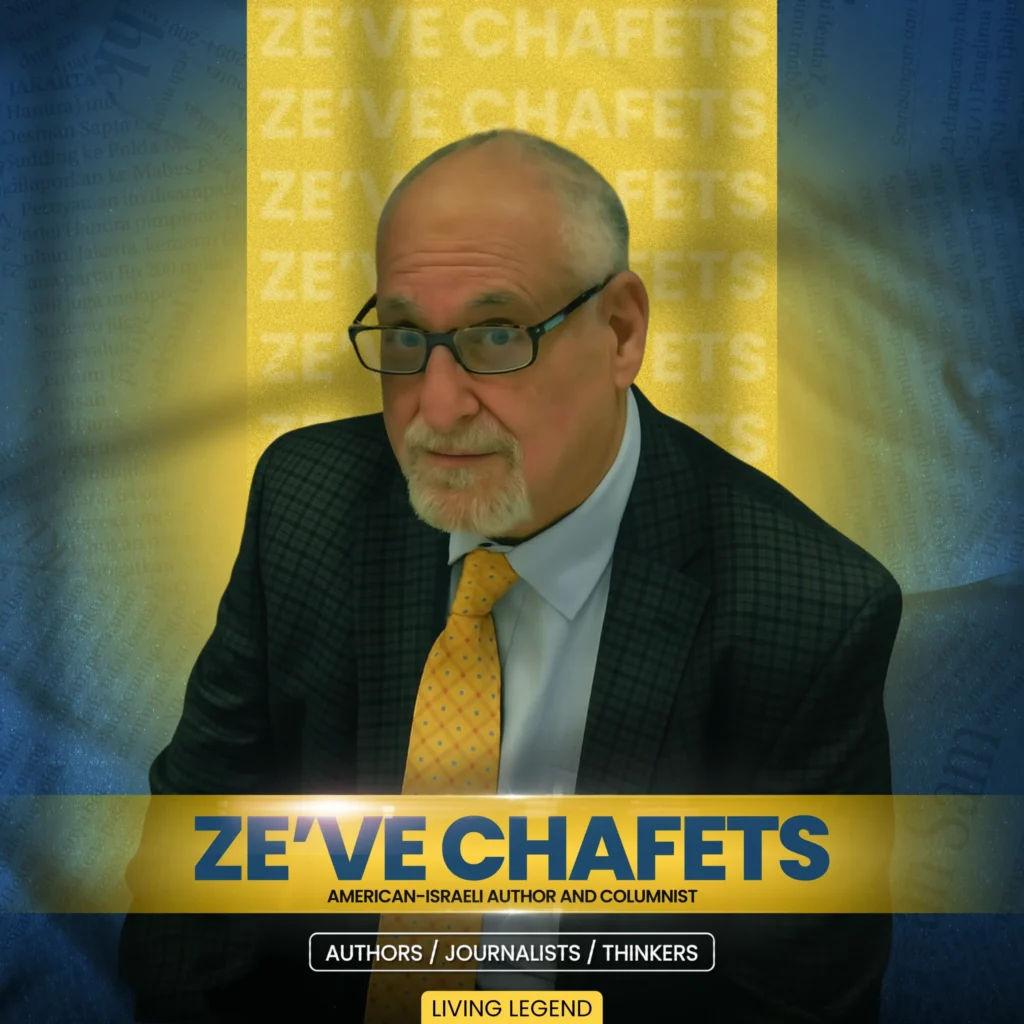
Ze’ev Chafets: From Motown to Jerusalem and Back Again

313 Legends

Ze'ev Chafets

Living Legend

Ze’ev Chafets: From Motown to Jerusalem and Back Again

Born: June 26, 1947, in Pontiac, Michigan
Detroit Era: 1948-1967 (Youth and Early Activism) - Thematic links remain.
Legacy: Journalist, novelist, and political commentator. His work focused on American conservatism, Israeli politics, sports figures, and cultural identity. A voice suspended between nations – always asking the uncomfortable questions.

Introduction

Before Ze’ev was William Chafets – a rough-around-the-edges kid raised just outside Detroit in an era when muscle cars and Motown harmonies still filled the streets.

Raised by working-class Jews in Pontiac, Michigan, Chafets watched factories hum and borders blur around racial, religious, and political lines.

Detroit in the 1950s and 1960s was a place of emergence and combustion, and it made Chafets a witness who was willing to go even where the story got messy…like halfway around the world into another powder keg: the Middle East.

A Detroit Upbringing in an Era of Upheaval

Although Chafets was technically raised in Pontiac, he grew up in Detroit’s cultural and political ferment.

The son of secular Jews, he was born in the heyday of rock ‘n’ roll and the height of Roosevelt liberalism, which saw him absorbing everything from Motown rhythms to racial segregation tensions and Vietnam-era politics.

Such early experiences – informed by Midwestern realism and socio-political fault lines – would go on to shape Chafets’ sharp, often contrarian worldview, which reached a head in 1967 when he left Michigan right at the time the Detroit Rebellion was about to explode to move clear across the world…to Israel.

Becoming Ze'ev: The Promised Land = Reimagination

In Israel, William Chafets became Ze’ev – Hebrew for wolf – a fitting name for his lone wolf journalism and geopolitics.

He went on to serve in the Israel Defense Forces, work in Israeli media, and eventually even became the director of the Government Press Office for Prime Minister Menachem Begin, a liaison between Israel and the international press corps.

Being near power gave Ze’ev rare access to image-making and narrative control – skills he would later exploit in columns and books.

He was neither an insider nor an outsider, a sentimentalist or a cynic.

What he was instead was an observer, one always lingering with a pen in hand in search of the next story to be told.

A Career in Contradictions

Chafets returned to the United States in the 1980s and wrote for the New York Times Magazine, the Los Angeles Times, Slate, and Newsweek.

His style has often been described as: “Direct, punchy, contrarian, and never safe.

He wrote over a dozen books, including:

“Heroes and Hustlers, Hard Hats, and Holy Men” (1986): a cross-country profile of America’s fringe and forgotten figures.

“Devil’s Night: And Other True Tales of Detroit” (1990): his literary return to Detroit – a love letter to the city of his youth.

“Rush Limbaugh: An Army of One” (2010): an unexpectedly nuanced biography of the polarizing radio host that won praise from both sides of the aisle.

“A Match Made in Heaven” (2007): the uncomfortable, transactional love affair of American evangelicals with the state of Israel.

He also regularly wrote about iconic figures such as Don King, Mike Huckabee, Barack Obama, as well as his Jewish identity, always asking the same question:

What exactly is Jewish identity, and what happens when ideology meets reality?

Detroit and Devil's Night

Chafets’ most visceral piece of work is “Devil’s Night”, a raw, honest portrait of a dying Detroit that was inspired by his return to the Metro area in the 1980s, where he found a city that had turned from an industrial superpower into a cautionary tale.

Arson, poverty, racial tension, and bureaucratic decay – all made their way into “Devil’s Night” – but so did resilience, humor, and rebellion.

All in all, Chafets refused to romanticize Detroit, but he could never quite leave it behind.

He was both an insider and an agitator, a patriot and a skeptic, and he lived between American and Israeli identities, writing like a surgeon with the pacing of a pulp novelist.

He never tried to be liked.

And that’s what made people want to look twice – at their heroes, their history, and their city.

All in all, Detroit taught Chafets the language of contradiction, and when he traded 8 Mile for Tel Aviv, it never quite left his blood.

In a world allergic to complexity, Chafets reminds us:

Truth rarely takes a side.

About the Author

Victoria Jackson

Victoria Jackson (Editor In Chief)

Victoria Jackson is a lifelong student and sharp-eyed documentarian of all things Detroit, from its rich musical roots and cultural icons to its shifting neighborhoods, storied architecture, and underground legends. With her finger firmly on the pulse of both the city’s vibrant past and its rapidly unfolding future, she brings a deeply personal, historically grounded lens to every piece she writes.

Published on: August 18, 2025