


 Please check your email for your login details.
If Detroit has a soul, Ruth Ellis was one of the first to tend to its flame.
In a city built on resilience and labor, she forged a harder path:
A black woman.
A lesbian.
And open about it before it was safe, or legal, or tolerated.
Eternal Legend
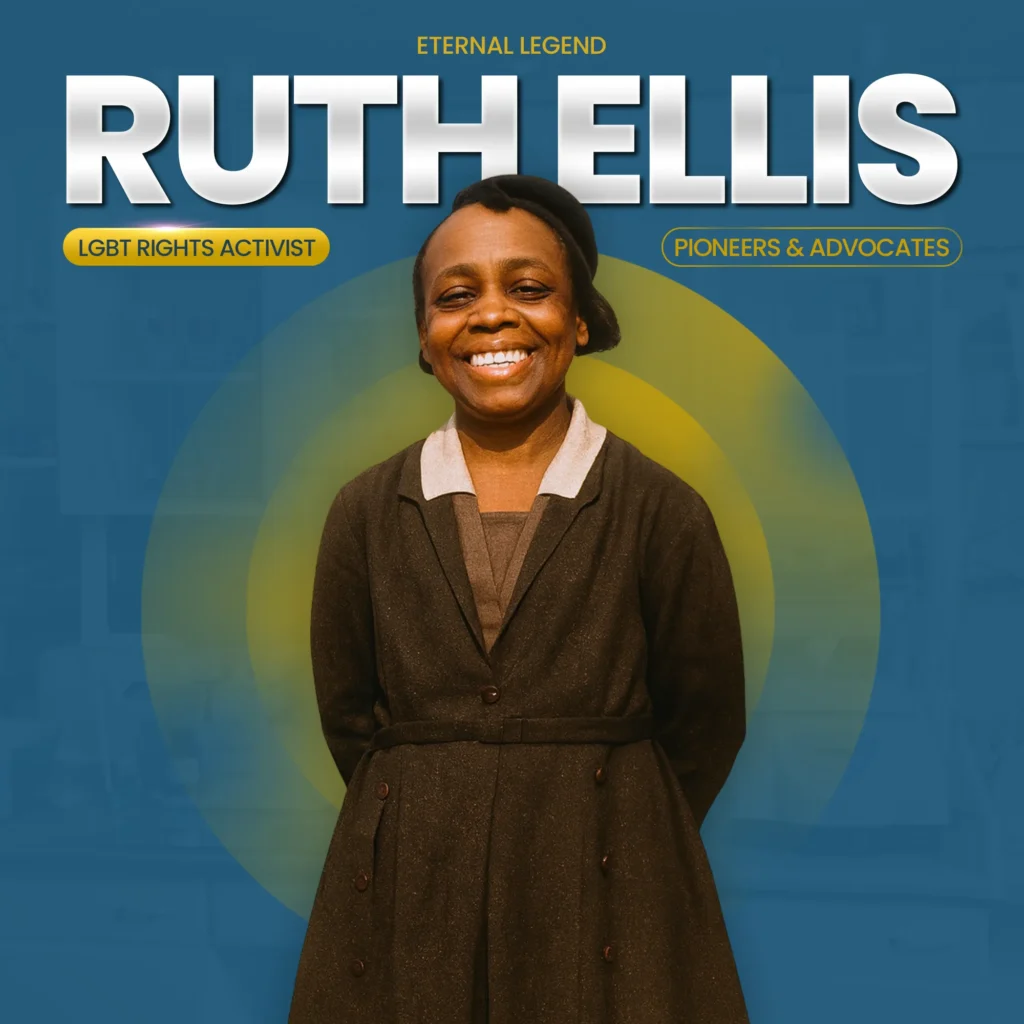
Born: July 23, 1899, Springfield, Illinois
Died: October 5, 2000, Detroit, Michigan
Detroit Era: 1937–2000
Legacy: The oldest known open Black lesbian in America, a fearless advocate for LGBTQ+ and Black youth, and founder of Detroit’s first known queer safe haven. A century-long witness to history—and a maker of it.
If Detroit has a soul, Ruth Ellis was one of the first to tend to its flame.
In a city built on resilience and labor, she forged a harder path:
A black woman.
A lesbian.
And open about it before it was safe, or legal, or tolerated.
Ruth Ellis was born prior to the turn of the 20th century to parents who taught her to read long before she ever attended school.
Her father, a formerly enslaved man that became a self-taught religious scholar, died when she was thirteen, but by then the blueprint for courage had already been laid.
During the 1910s, she came out as a lesbian.
No parades. No Instagram posts.
Just quiet truth lived fully.
Ruth and her partner Ceciline “Babe” Franklin relocated to Detroit in 1937, where they purchased a house on West Philadelphia Street together that quickly became known as more than just a house.
It was a place of refuge, a counseling center, a printing press, and an unspoken halfway house for Black, queer men and women with nowhere else to go.
The neighborhood called it “The Gay Spot.”
Ruth Ellis provided queer kids with exactly what the world refused to give them long before nonprofits or hashtags were ever a thing:
A sanctuary where they could obtain a hot meal.
A comfortable sofa.
A laugh.
A haircut.
She also utilized her basement as a printing press, a rare feat for a Black woman at that time, keeping the lights on with her business savvy acumen/
She never locked her front door.
She never charged rent.
Instead, she allowed the world in and challenged it to do better.
Ruth watched and supported quietly while the civil rights movement marched on, and when Detroit was destroyed and rebuilt, she remained firmly rooted, refusing to throw in the towel on the city she loved.
By the 1990s, Ruth was a fixture in a number of documentaries, interviews, and public appearances.
She was even a guest of honor at the national Pride and Black lesbian conferences.
By the time she reached the age of 100, she was a symbol, not just a survivor.
One year prior to her passing in 1999, the Ruth Ellis Center for LGBTQ + youth was founded in Highland Park, going on to become a nationally recognized shelter as well as an advocacy hub for LGBTQ + youth, particularly those of color.
Her legacy is housed in every bed that the center offers.
In each life it helps reclaim.
In every queer kid that strolls through its front doors and feels safe and secure somewhere for the first time in their lives.
Ruth Ellis never asked for permission to exist.
She didn’t wait around for allies.
In a world where her kind were used to moving in silence, she developed a sanctuary…one built on radical love and recognition, where she lived until she was 101 dancing, laughing, and defying.
In short, she refused to permit the world to steal her joy.
For that, Detroit and the LGBTQ+ community as a whole will never forget her.

Victoria Jackson (Editor In Chief)
Victoria Jackson is a lifelong student and sharp-eyed documentarian of all things Detroit, from its rich musical roots and cultural icons to its shifting neighborhoods, storied architecture, and underground legends. With her finger firmly on the pulse of both the city’s vibrant past and its rapidly unfolding future, she brings a deeply personal, historically grounded lens to every piece she writes.
Published on: August 18, 2025