
or

By signing in, I accept the Rebuildetroit.com Terms of Use.

Agent Registration

Find Your Agent Profile

Agent Registration

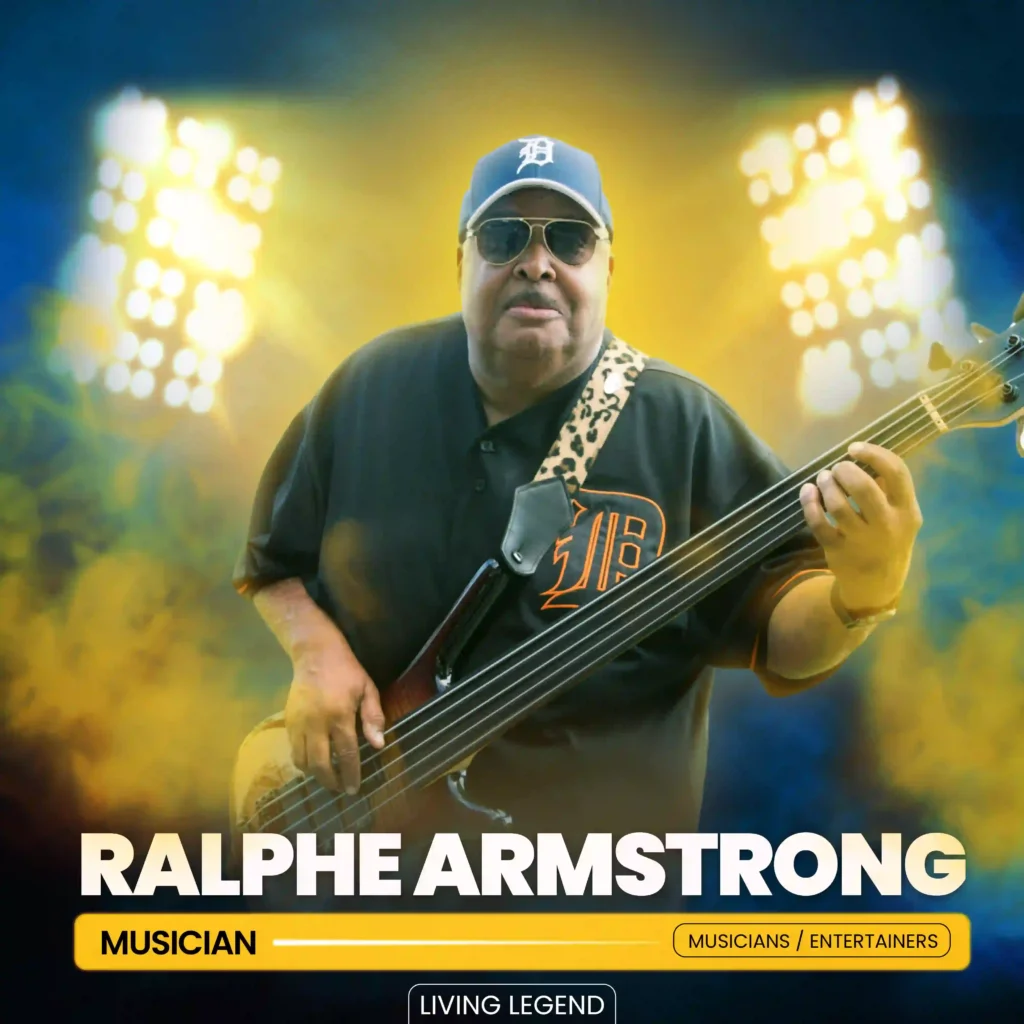
Ralphe Armstrong: Detroit’s Fretless Fusion Pioneer

313 Legends

Ralphe Armstrong

Living Legend

Ralphe Armstrong: Detroit’s Fretless Fusion Pioneer

Born: May 17, 1956, Detroit, Michigan
Detroit Era: 1956–present
Legacy: A virtuoso bassist bridging classical technique, jazz, and fusion. Rose from Detroit’s vibrant clubs to become a foundational member of the Mahavishnu Orchestra and a key contributor to jazz fusion’s evolution. Shaped the next generation as a teacher, union leader, and champion of Detroit's musical roots.

Introduction

Ralphe Eames has always had a voice that’s impossible to miss.

His playing is expressive, full of character, and rooted in both Detroit’s strong jazz lineage and a fusion of various eclectic genres.

As far as his early years, Armstrong’s father, Howard “Louie Bluie” Armstrong, was a fiddler and storyteller, and his uncle Lee “L.C.” Crockett played bass, which taught Ralphe how to follow in their footsteps by the age of 10.

Ralphe then went on to pursue more formal classical training, studying upright and electric bass at the prestigious Interlochen Arts Academy in Michigan at a time when Detroit was most known for its booming music culture.

Motown, R&B, jazz – Armstrong soaked it all up with plenty of discipline and a desire to improvise wherever he saw fit.

Mahavishnu Orchestra Breakthrough

At the age of 17, Ralphe auditioned for John McLaughlin’s Mahavishnu Orchestra.

The fretless electric bass was his specialty, and with Mahavishnu, Armstrong would go on to record “Apocalypse” (1974), “Visions of the Emerald Beyond” (1975), and “Inner Worlds” (1976).

He gave the band a distinct sense of character: free singing that sounded equally as good on melodic solos as it did on anchoring grooves.

For a Detroit teen, it was a jumpstart into the unique world of global fusion.

Beyond Mahavishnu: The Expanding Voice of Fusion

Armstrong followed up his time with Mahavishnu with violinist Jean-Luc Ponty for “Enigmatic Ocean” (1977) and “Cosmic Messenger” (1978).

These albums showed he could weave intricate rhythms and harmonies into an orchestral fusion sweep.

Armstrong then went on to work with legends like Frank Zappa, Carlos Santana, Herbie Hancock, and other Detroit greats like Geri Allen.

His versatility enabled him to play highly charged fusion, soulful jazz, and symphonic collaborations with acclaimed ensembles such as the London Symphony Orchestra.

At the height of his global career, Armstrong’s playing had that signature Detroit sound: bluesy, jazzy, and raw.

He played fretless bass and sang with soul – the very qualities that made Detroit musicians so distinctive – all without ever losing his ability to move across genres.

Still riding that high, Armstrong returned to Detroit despite his international fame, not just as a successful musician, but as a teacher and advocate.

His lessons in discipline and creativity gave him quite the reputation at Oberlin Conservatory, Wayne State University, and Cass Technical High School.

He was also a man of the people, joining music unions to help fight for fair wages and protections for working musicians.

Final Word

In summary, Ralphe Armstrong’s career serves as one strong link connecting Detroit’s unique jazz scene to the international stage.

To this day, he remains one of the genre’s most expressive voices, and he will forever be remembered as both a teenage prodigy and an experienced mentor.

As far as Detroiters are concerned, Armstrong is living proof that the city has produced innovators capable of changing the sound of music itself…one that truly shines in a lane he paved all on his own.

About the Author

Victoria Jackson

Victoria Jackson (Editor In Chief)

Victoria Jackson is a lifelong student and sharp-eyed documentarian of all things Detroit, from its rich musical roots and cultural icons to its shifting neighborhoods, storied architecture, and underground legends. With her finger firmly on the pulse of both the city’s vibrant past and its rapidly unfolding future, she brings a deeply personal, historically grounded lens to every piece she writes.

Published on: August 20, 2025