
or

By signing in, I accept the Rebuildetroit.com Terms of Use.

Agent Registration

Find Your Agent Profile

Agent Registration

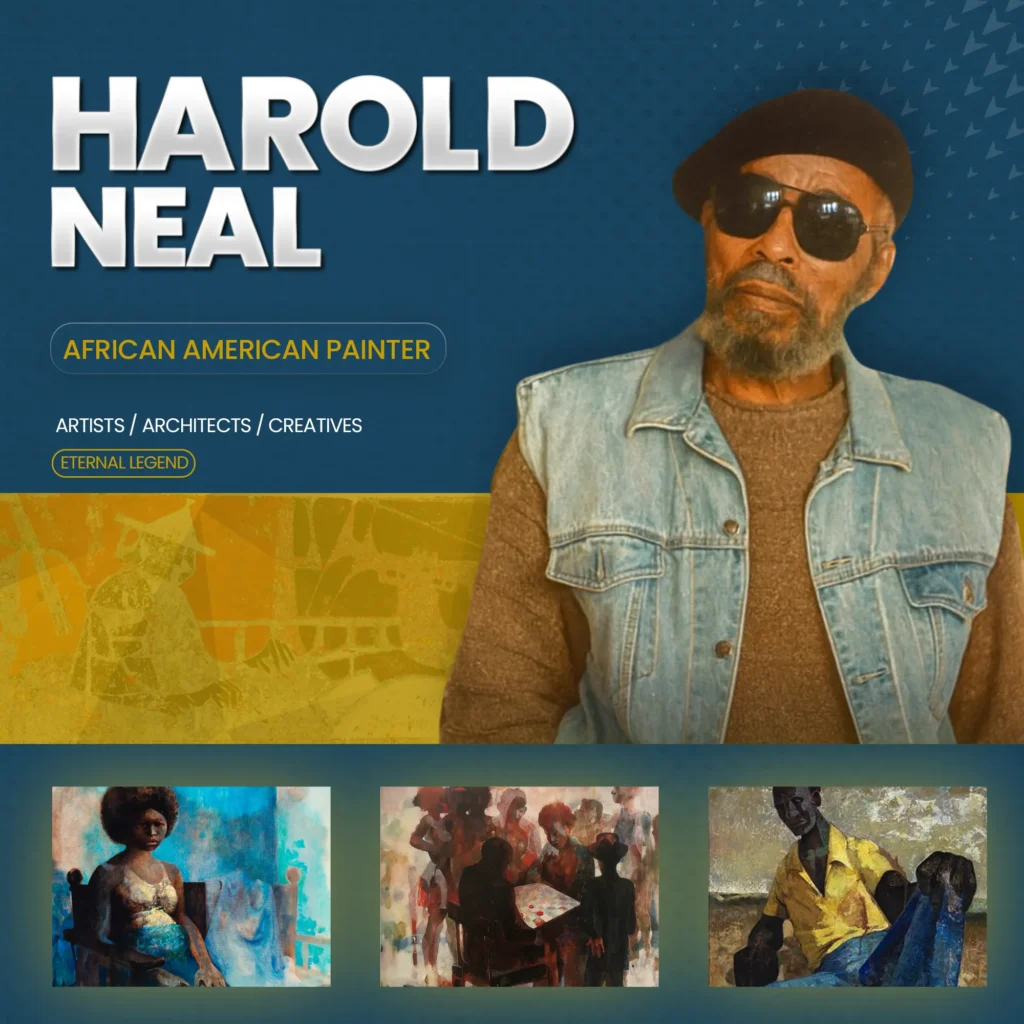
Harold Neal: Detroit’s Painter of Protest

Categories: ARTISTS

313 Legends

Harold Neal

Eternal Legend

Harold Neal: Detroit’s Painter of Protest

Born: December 19, 1924, in Detroit, Michigan
Died: May 6, 1996, in Detroit, Michigan
Detroit Era: 1924-1996
Legacy: American painter and a strong voice in Detroit's Black Arts movement.

Introduction

Harold Neal was one of the most memorable visual storytellers to emerge from Detroit’s early-20th century Black Arts Movement, known for his paintings that were often fiery, mournful, and celebratory—giving a voice to the struggles and triumphs of African Americans in the mid-20th century.

Neal’s work captures both the rage of oppression and the beauty of Black life, cementing his reputation as one of Detroit’s leading artists.

An Impactful Detroit Upbringing

Every brushstroke Neal ever put on a canvas took place in Detroit, with the noise, labor, and grit of its peak industrial era defining his environment just as much as the racial segregation and inequality that made him acutely aware of injustice.

In his later years, he trained at Detroit’s Society of Arts and Crafts (now the College for Creative Studies), which would be where he first developed a skill set capable of transmuting the struggles of his environment into something beautiful.

A Painter of Protest

Neal began producing some of his most raw work in the 1960s at a time when the civil rights movement was sweeping across the nation and Detroit was erupting as one of its hubs.

His canvases showcased the racism, poverty, and violence that was so prevalent in Detroit at this time, affording his people little in the way of comfort.

His most powerful series during this era went as far as showing Black figures shackled, beaten, and defiant – images recalling marches, police brutality, and racial injustice that demanded viewers feel that pain and that urgency – not turn away from it.

Looking Beyond Trauma: Celebrating Black Life

Although Neal’s early work reflected the collective cries of his people and their fight for equality, that would not be the entire focus of his career.

He was just as devoted to celebrating African American culture, photographing and painting communities of Black families, musicians, and everyday people with dignity and vibrancy.

He painted jazz players moving, children playing, and couples hugging – pieces full of color that radiated joy and strength.

In short: Neal understood that Black Detroit was a story not just of struggle, but one of creation and endurance.

Educator and Mentor

Along with painting, Neal taught art in Detroit schools and worked with young artists trying to find their footing in the art world.

He firmly believed that art could educate, inspire, and change, encouraging his students in classrooms and workshops to always tell their own stories – whether it was with paint, clay, or charcoal.

His paintings mirror his role as an educator: uncompromising, honest, and heavily invested in the bright future of Black America.

Recognition and Impact

Harold Neal exhibited in Detroit and all around the world during the 1960s and 1970s, joining a national movement of Black artists that refused to be politically correct in their aesthetics.

Though he never enjoyed the mainstream acclaim of his white contemporaries, he was considered a pioneer within Detroit’s Black Arts community, with many of his paintings found in museum collections, university archives, and private collections even decades after his death.

He is remembered as a man who painted urgently, with fire and with love, showing Detroiters images of its struggle and spirit while refusing to be sanitized or softened.

For Detroit, Harold Neal is a truth-teller – an artist who gave the cruelty of injustice and the beauty of resilience form and color.

About the Author

Victoria Jackson

Victoria Jackson (Editor In Chief)

Victoria Jackson is a lifelong student and sharp-eyed documentarian of all things Detroit, from its rich musical roots and cultural icons to its shifting neighborhoods, storied architecture, and underground legends. With her finger firmly on the pulse of both the city’s vibrant past and its rapidly unfolding future, she brings a deeply personal, historically grounded lens to every piece she writes.

Published on: August 23, 2025