
or

By signing in, I accept the Rebuildetroit.com Terms of Use.

Agent Registration

Find Your Agent Profile

Agent Registration

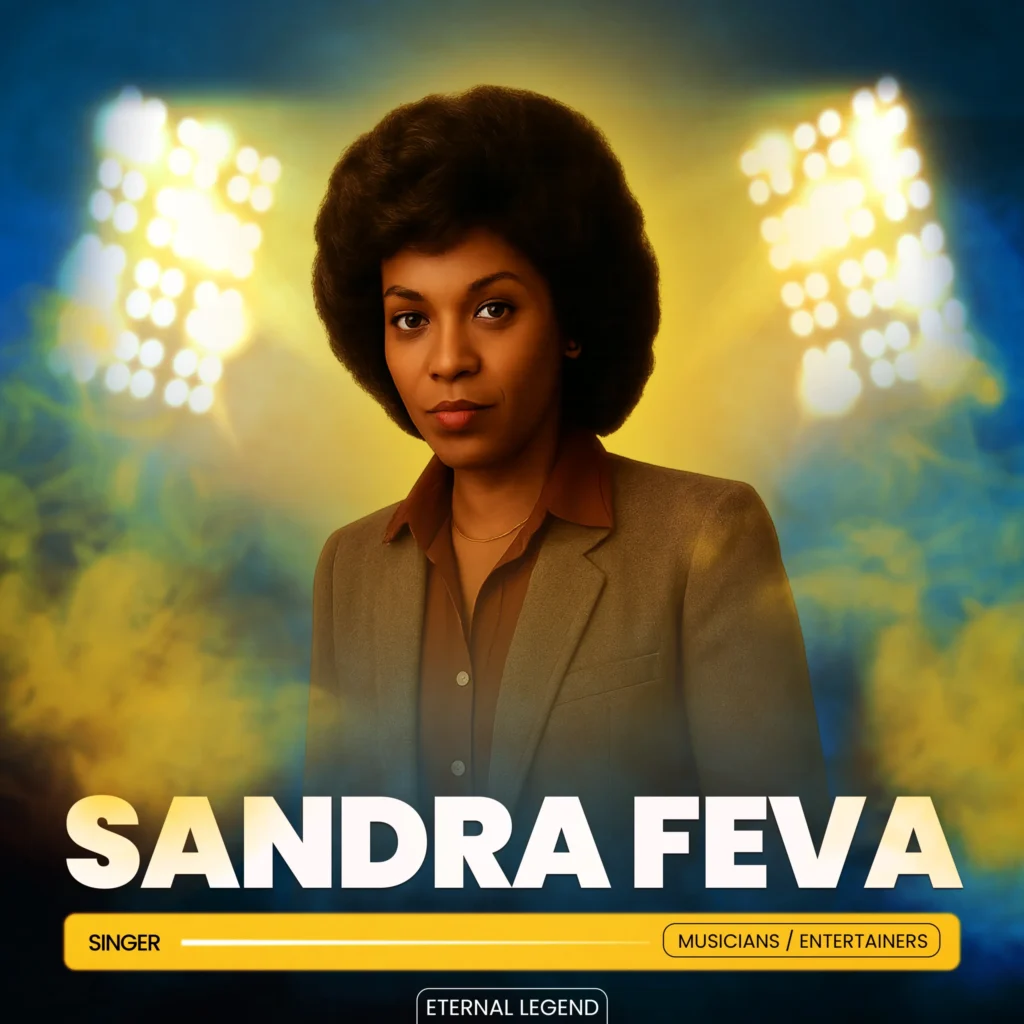
Sandra Feva: The Voice That Carried the Background into the Spotlight

313 Legends

Eternal Legend

Sandra Feva: The Voice That Carried the Background into the Spotlight

Born: Sandra Arnold – May 14, 1947 – Los Angeles, California
Detroit Era: 1950s–2020
Legacy: R&B vocalist, iconic background singer, and unsung soul architect.

Introduction

Sandra Feva is a woman best known for lending her powerhouse voice to Motown legends, but that doesn’t mean she doesn’t have a rich catalog of her own.

A child of Los Angeles, Sandra was raised in Detroit from her early years, and it would be there that her voice would begin to take shape, with her honing her range in church choirs, talent shows, and neighborhood gigs.

Detroit isn’t the kind of place that hands out compliments easy, but Sandra wasn’t the type to chase after the easy route.
She recorded her first tracks under the pseudonym “Sandra Richardson” in the late 60s and early 70s, quickly gaining a reputation as the woman with a voice you could feel straight down into your bones.

She recorded her first tracks under the pseudonym “Sandra Richardson” in the late 1960s and early 1970s, quickly gaining a reputation as the woman with a voice that you could feel straight down to your bones.

Soul from the Shadows

By the late 1970s, Sandra’s vocal talents landed her in the studio alongside some of the biggest names to ever make waves in R&B and funk.

Before she knew it, she was singing background for everyone from Aretha Franklin to George Clinton to Parliament-Funkadelic, Prince, and Teena Marie—sometimes even outshining them on their own stage.

A master of harmony, she wasn’t just a background singer.

She was often the very backbone of the performance, the kind of vocalist who could lift a chorus into the rafters.

Section 3

Sandra Feva stepped into the spotlight with a series of solo releases that were a cross between silky ballads and quiet storm arrangements.

Hit songs like “Tell ’Em I Heard It” and “You Can’t Come Up Here No More” showcased her easy-going signature style: chill, mature, emotional, and above all else…vocally flawless.
She was never the kind of artist that had to belt her way through songs.

She lived within them.

In the early 1980s, she landed R&B radio success with singles like “The Need to Be” and “If You Want It, You Got It,” the latter of which quickly became a quiet storm staple.

From there, her albums “Kick It,” “The Need to Be,” and “Savoir Faire” further cemented her as a musical icon in her own right—even if mainstream fame never quite caught up to the quality of her catalog.

Prince’s Seal of Good Luck and the Industry’s Secret Weapon

Sandra Feva’s biggest break came in the mid-1980s when Prince invited her to join his band as a touring background vocalist.
It was just the endorsement she needed to break through to the big leagues.

Feva didn’t just tour with him; she also contributed heavily to his studio sessions, adding her sultry tone to the purple kingdom’s complex musical DNA.

Her range, control, and professionalism made her a go-to vocalist in sessions all over Detroit.

She never chased the charts.

She chased emotion, and she delivered it in every note.

Life Beyond the Spotlight

Later in life, Sandra left the industry behind, choosing instead to shift her focus over to spiritual work.

She became an ordained minister and focused her attention on uplifting others, drawing them to Christ.

Even then, her legendary voice remained a core part of her ministry work all the way until the end of her life—whether she was preaching or engaging in the occasional gospel performance.

Death of an Icon

In 2000, Sandra Feva suffered a stroke that ended her singing career, and sadly, she passed away shortly after.

However, to those who knew her, her impact was huge: she was a star in every sense of the word, even if she didn’t ask for the title. One who made every song she touched richer, deeper, and that much more authentic.

In short, she wasn’t just a background singer.

She was Detroit’s best kept vocal secret—steady, sacred, and always in tune with something higher.

About the Author

Victoria Jackson

Victoria Jackson (Editor In Chief)

Victoria Jackson is a lifelong student and sharp-eyed documentarian of all things Detroit, from its rich musical roots and cultural icons to its shifting neighborhoods, storied architecture, and underground legends. With her finger firmly on the pulse of both the city’s vibrant past and its rapidly unfolding future, she brings a deeply personal, historically grounded lens to every piece she writes.

Published on: September 17, 2025