
or

By signing in, I accept the Rebuildetroit.com Terms of Use.

Agent Registration

Find Your Agent Profile

Agent Registration

Diego Rivera: The Brush that Shook Detroit

313 Legends

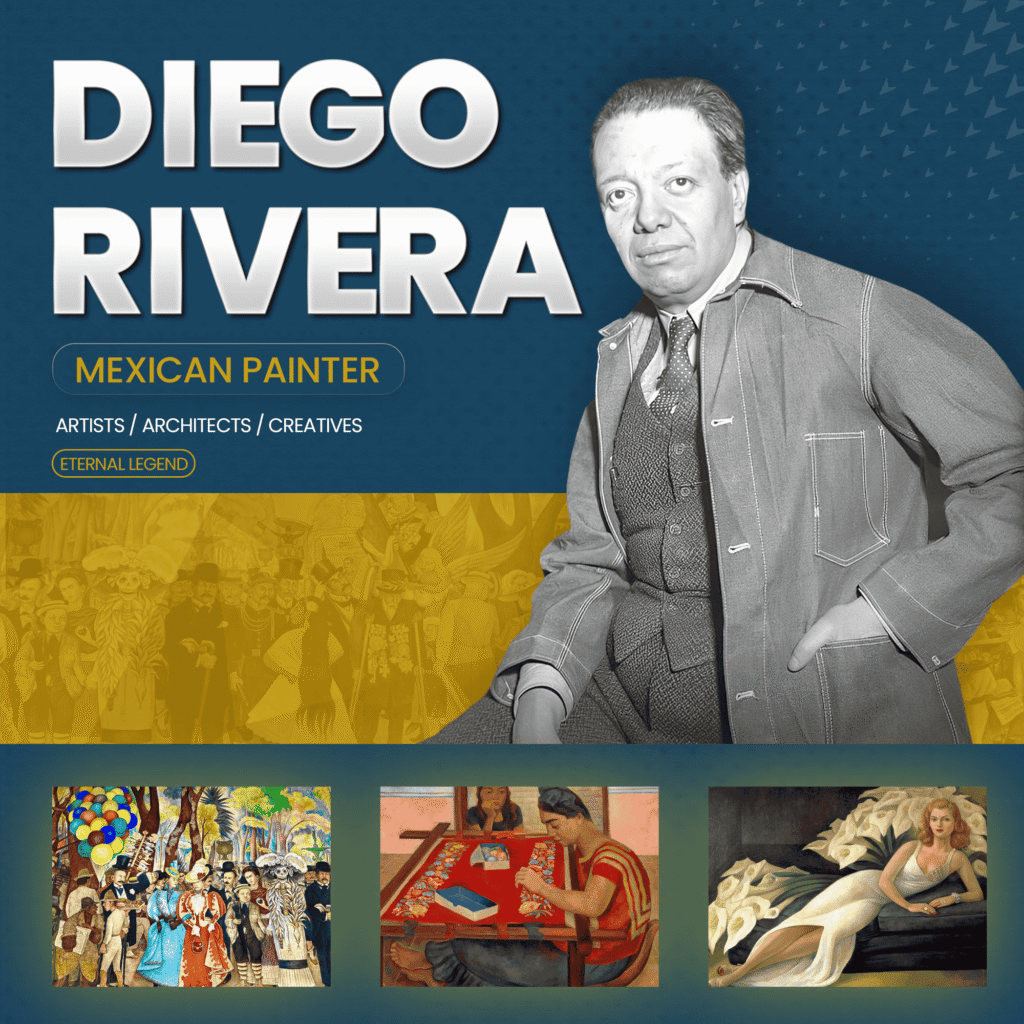
Diego Rivera

Eternal Legend

Diego Rivera: The Brush that Shook Detroit

Born: December, 8, 1886, in Guanajuato, Mexico

Died: November 24, 1957, in Mexico City

Detroit Era: 1932-1933 (Detroit Institute of Arts Murals)

Legacy: Famous Mexican muralist, creator of the Detroit Industry Murals, Marxist firebrand, husband of Frida Kahlo, and one of the most important American artists of all time.

Introduction

Diego Rivera did not just paint walls.

Rivera did not just paint walls. 

He crafted revolutions in concrete.

Rivera arrived in Detroit in April 1932 to find the city struggling under the weight of the Great Depression.

It was a time when unemployment was high, factories were closed, and stomachs were empty.

Black smoke hung from the skyline, and the mood was somber and gray.

And yet, out of that bleak canvas stepped Rivera: barrel-chested, defiant, brilliant.

He brought color. 

Meaning.

Fire.

Months later, he would transform the Detroit Institute of Arts into a temple for the working class – and scandalize the city’s elite at the very same time.

The Revolutionary Brushman

When Rivera first arrived in Detroit, invited by Edsel Ford and DIA director William Valentiner, he was already a legend. 

His frescoes in Mexico honored laborers, farmers, and indigenous peoples.

He was a proud Marxist who loathed American capitalism, yet he was financed by some of its wealthiest patrons – not in Detroit, but in San Francisco, his first American stop.

Indeed, San Francisco was where Rivera really delved into the belly of the beast, creating his first few masterpieces.

It was only after that when he found his way to Detroit.

The Detroit Industry Murals

During his Detroit era, Rivera sketched machines, workers, gear-toothed engines, chemical labs, and assembly lines at Ford’s River Rouge Plant.

It wasn’t just the technology, but the rhythm of labor that had him spellbound.

What he saw was more than just industrial might; it was a creation myth.

From July 1932 through March 1933, Rivera painted 27 panels over four DIA walls as part of his iconic Detroit Industry Murals.

The work featured:

Giant assembly lines with men and machines intertwined.

Medical and biological metaphors for industry, including a child being born.

Workers of every race standing in gritty solidarity.

Gods of the Aztecs, Christian references, scientific symbolism, and Marxist ideology.

This was no ordinary mural.

This was a collision:

One part scripture, one part warning, one part symphony.

Beauty or Blasphemy?

When Diego’s murals debuted, Detroit split into two.

Some called it communist propaganda. 

Some religious leaders called it sacrilegious, especially the panel for a nativity scene in which a baby emerges from a bulb of plant life accompanied by nurses instead of angels.

But Detroit legend and businessman Edsel Ford was a vocal advocate.

He defended Rivera’s work, stating:

“I like Rivera’s spirit. I really I think he’s expressing his idea of Detroit.”

As for Rivera, he laughed it off.

For him, controversy was not failure.

It was fuel.

Frida in the Shadows

Diego Rivera’s wife, the iconic Frida Kahlo, joined Rivera on his Detroit commission.

One of her most traumatic moments was later painted in the haunting Henry Ford Hospital (1932), which recalls the time she miscarried their child at Henry Ford Hospital.

It was an ordeal that left her bruised, but it also burned its way into her art.

While Rivera painted labor on walls, Frida painted pain about it on her canvas, making her time in Detroit just as personal and public as his.

Life After Detroit

Rivera would go on to become even more famous and face even more challenges.

In New York, he painted the tragic Rockefeller Center mural (which was destroyed because it included Lenin), and after that, he spent his time painting in Mexico until he died in 1957.

That said, Rivera always thought Detroit provided him with the best opportunity of his career.

Not necessarily for scale, but for authenticity.

Legacy: The City's Crown Jewel

As of today, Diego’s Detroit Industry Murals are considered among the finest examples of 20th-century public art.

They became a National Historic Landmark in 2014 and are still free to view inside the DIA, a place where the murals hum with life, reminding us of what was built, what was broken, and how a city was forged out of muscle, metal, and will.

Final Word: The Walls That Speak

Diego Rivera did not just paint Detroit.

He decoded it.

He turned working men into gods, machines into monuments, and steel into a symbol.

He was not from here. 

He did not stay. 

But his work left a permanent mark.

About the Author

Victoria Jackson

Victoria Jackson (Editor In Chief)

Victoria Jackson is a lifelong student and sharp-eyed documentarian of all things Detroit, from its rich musical roots and cultural icons to its shifting neighborhoods, storied architecture, and underground legends. With her finger firmly on the pulse of both the city’s vibrant past and its rapidly unfolding future, she brings a deeply personal, historically grounded lens to every piece she writes.

Published on: June 26, 2025