or

By signing in, I accept the Rebuildetroit.com Terms of Use.

Agent Registration

Find Your Agent Profile

Agent Registration

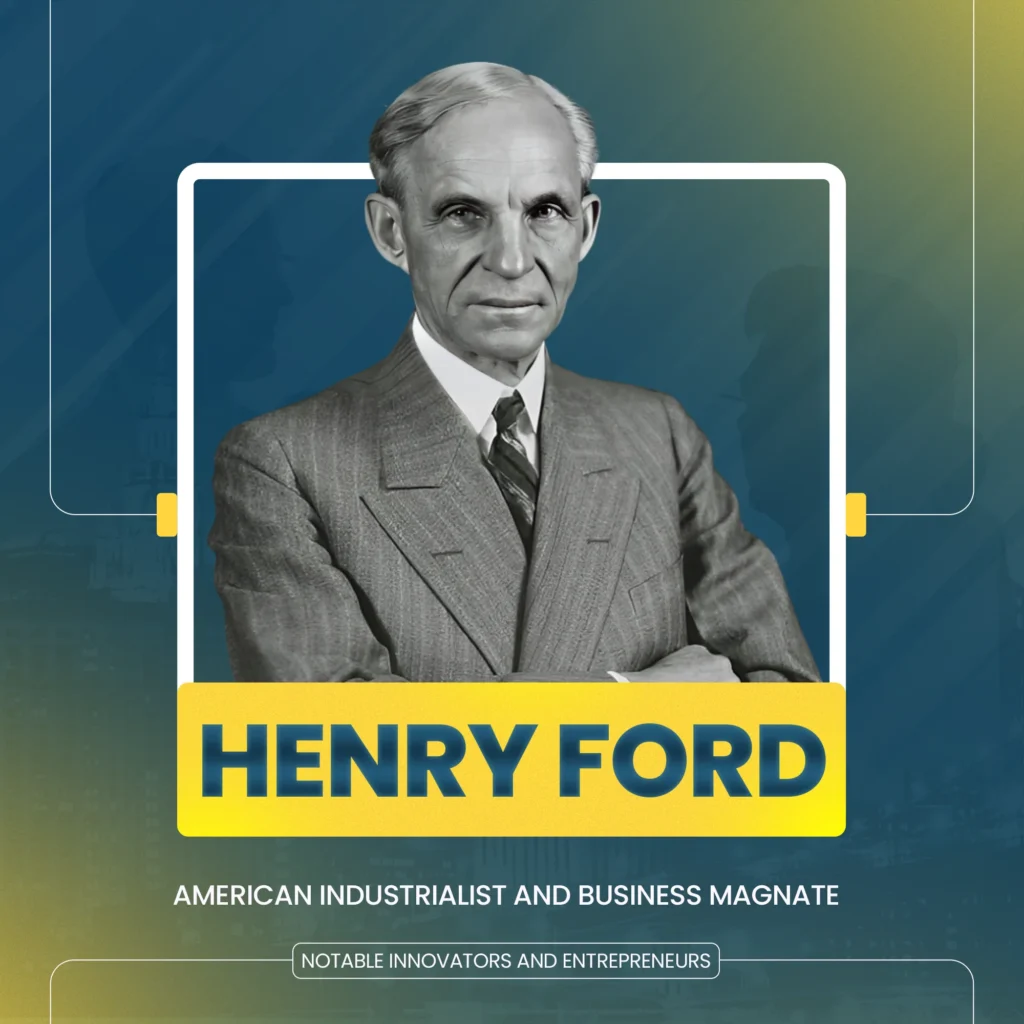
Henry Ford: The Man Who Mass-Produced the Future

313 Legends

Henry Ford

Eternal Legend

Henry Ford: The Man Who Mass-Produced the Future

Born: July 30, 1863, in Greenfield Township, Michigan

Died: April 7, 1947, in Dearborn, Michigan

Detroit Years: 1879-1947

Notable Moment: Ford Motor Company was founded in Detroit in 1903.

Legacy: Revolutionized modern manufacturing; Changed the 20th century.

Introduction

Henry Ford is a man of myth – of big dreams made manifest.

One such myth is that the car was invented by him.

It wasn’t.

That honor belongs to the late Karl Benz.

Instead, what Henry Ford invented (and tuned to perfection with a machinist’s precision) was America’s obsession with motion.

Ford's Early Years

Born just outside Detroit on a farm in Greenfield Township (now Dearborn), young Henry Ford was more fascinated by gears than grain.

His first engineering experiment was dismantling and rebuilding a pocket watch at the age of 15, and while farming was what fed his family, what Henry wanted was to feed the future.

At 17, he left the farm for Detroit at a time when the city was an enclave of iron foundries and lumber barons – not yet the motor mecca it would later become – entering the clattering, soot-covered city with only his curiosity and a knack for machines backing him.

Little did anyone know… he would soon go on to change not only Detroit, but the entirety of modern life.

The Making of a Tinkerer

Ford made Detroit his forge, becoming an apprentice machinist with James F. Flower & Bros. and later the Detroit Dry Dock Company. 

While others his age were still being told what to do, Ford was already reshaping reality with tools and blueprints. 

The young machinist never stopped learning, busying himself working on steam engines, clockwork, combustion, and dreaming of a more industrious future for Detroit and the world at large. 

Ford married Clara Bryant and worked for the Edison Illuminating Company in 1888, becoming their Chief Engineer by 1893. 

His nights, on the other hand, were dedicated to his true obsession: constructing a horseless carriage.

The Quadricycle and the Beginning of it all

It was the turn of the century, and Detroit was on the verge of a combustion boom, with Ford, Ransom Olds, the Dodge Brothers, and hundreds of backyard inventors all racing in the same direction.

However, unlike many of his direct competitors, Henry never desired to create just another plaything for the rich.

He wanted a machine for the masses.

And so, in 1896, at 58 Bagley Avenue in a tiny brick shed, Henry Ford built his first gasoline-powered car – the Quadricycle – as the entire city watched on with equal parts amusement and skepticism.

The thing rattled like a tin can and moved barely fast enough to scare a horse.

But Ford saw beyond the noise:

He pictured roads stretching clear across America, connecting farms to cities and freeing the working man from the bondage of being stuck in one location.

It was a vision that led to the birth of the Ford Motor Company in 1903, with Henry choosing Detroit for its headquarters.

If industrial ambition fueled the city, Ford put gasoline on it, going on to introduce the Model T in 1908 and inventing manufacturing with the first moving assembly line at the Highland Park Plant in 1913.

Just like that, Detroit became more than a city.

It was the birthplace of America’s future.

The Rebranding of Detroit in Ford's image

Everything about industrialization changed with the Model T (and with it, a five-dollar-a-day wage for factory workers), making Detroit the crown jewel of American industry.

It was a time that saw huge waves of migrants arriving in Michigan in droves, both black workers from the South and immigrants from Europe, all who were looking for work on the Ford production line.

Neighborhoods swelled.

Union halls ignited.

Suddenly, the blueprint for the 20th century’s American dream was Detroit – and Ford was the architect – for better or for worse.

In short, Ford wasn’t just making cars. 

He built an entire ideology.

He made machines that erased rural simplicity and romanticized life on the road.

He scoffed at bankers and Wall Street suits yet ran one of the world’s most powerful corporations, seeing himself as a moral steward who built company towns like Fordlandia and enforced “moral codes” for his workers, even going as far as checking their homes for cleanliness.

Under Ford, Detroit was booming, and while his empire brought in plenty of money, it also created tension. 

Labor strikes.

Race riots.

Exploitation.

And through it all, Ford was admired, feared, and impossible to ignore.

The Dark Side of the Assembly Line

Every gear Ford tuned had a darker bolt wedged just behind it. 

He was a visionary, no doubt about that, but he was also complicated – not to mention contradictory.

He hated war yet let Ford factories make tanks for WW II. 

He paid workers well, yet crushed union efforts with a private security force led by Harry Bennett.

There was also antisemitism – something that history will not forget.

His newspaper, the Dearborn Independent, published the International Jew, a series of antisemitic articles in the 1920s, and Adolf Hitler was said to have liked Ford so much he kept a portrait of him in his Munich office.

Ford later apologized, but the damage was done, with many Detroiters never quite looking at him the same and others continuing to revere him, sweeping his many undesirable qualities under the rug in favor of his achievements.

Final Years and Death

By the 1940s, age had caught up with Ford.

His son Edsel died in 1943 of stomach cancer, and the heartbroken, frail Henry returned as company president of Ford for a brief time after the fact, although he was not the same man who had electrified it in the 1910s and 1920s.

At the age 83, on April 7, 1947, Henry Ford died in Fair Lane, his Dearborn estate.

It was a death that marked the end of an entire era – but his machines never stopped moving.

He created a world based on his vision. 

Highways. Suburbs. Shift whistles. 

Global production models that transformed a modest midwestern town into an empire of steel.

A Complicated Legacy

Every engine Detroit has ever produced bears Henry Ford’s story.

You’ll find him among the soot of the old River Rouge Plant. In the bones of the Motor City. In the roar of a Mustang’s engine. And in the stillness of a ghost town that once thrived.

His wheels gave America the push forward it needed, but he also laid out a blueprint for how boyhood dreams can become busy factories – and how those same factories can go on to swallow entire cities whole.

About the Author

Victoria Jackson

Victoria Jackson (Editor In Chief)

Victoria Jackson is a lifelong student and sharp-eyed documentarian of all things Detroit, from its rich musical roots and cultural icons to its shifting neighborhoods, storied architecture, and underground legends. With her finger firmly on the pulse of both the city’s vibrant past and its rapidly unfolding future, she brings a deeply personal, historically grounded lens to every piece she writes.

Published on: June 26, 2025