


 Please check your email for your login details.
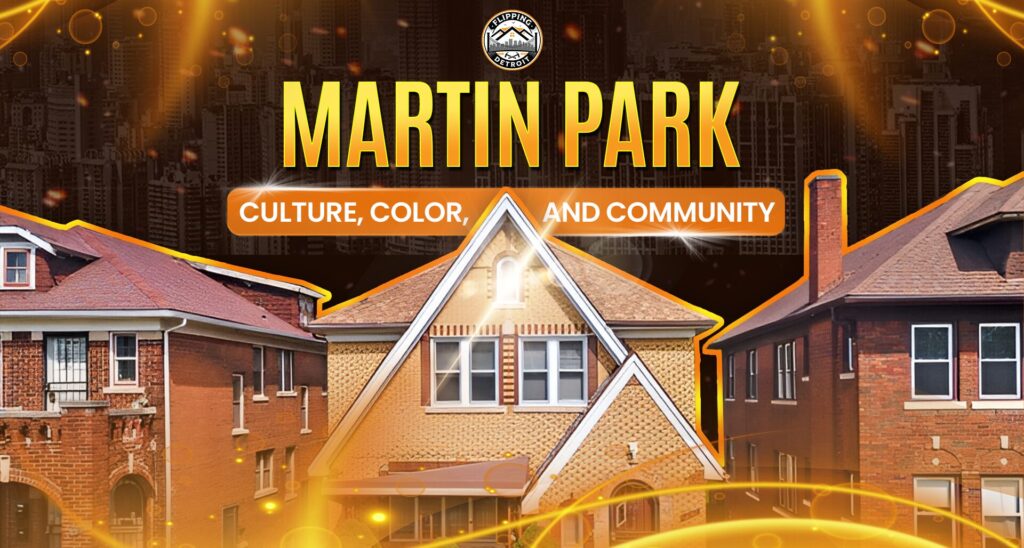
Located just a short drive from some of the city of Detroit’s most major cultural and educational landmarks (University of Detroit Mercy and Marygrove Conservancy), Martin Park is a charming residential pocket that is home to everyone from longtime homeowners to renters and new families looking to put down solid roots somewhere relaxed, grounded, and continuously evolving.
Being right within reach of UD Mercy, Martin Park is also known for its constant stream of students and faculty, and while the nearby historic Marygrove campus is no longer an active college, it has since reimagined itself as an epicenter for arts, higher education, and community programs.
It’s the kind of place where there’s always some kind of lecture, concert, or youth mentorship activity unfolding, helping bolster Martin Park’s reputation as a place of engagement, sensible entertainment, and opportunity.
Historical Information
Martin Park first came into being during Detroit’s mid-century expansion, offering affordable, sturdy ranches, brick colonials, and duplexes to the city’s quickly expanding middle class.
Today, many of those homes are still standing, easily identified by their old-world charm detailing, such as arched doorways, limestone accents, decorative masonry, and large front porches—the kind of architecture that tells a story.
Residents here take great pride in where they live, with many claiming they stuck around through Martin Park’s many highs and lows because of the neighborhood’s culture and strong sense of belonging.
As for newcomers, they find out pretty quickly upon moving into the Martin Park area that their neighbors are both protective of their blocks and eager to share in the community’s ongoing progress.
While many blocks shine thanks to well-manicured front lawns and homes that have been given a new layer of fresh paint, a few others reflect Detroit’s fleeting struggles with economic strain.
In that way, the Martin Park neighborhood straddles the thin line between Detroit’s rocky past and its promising comeback season – steady progress punctuated by occasional challenges – earning it a 5.4 middling neighborhood grade from various review sites that weigh factors like housing quality, amenities, and overall safety.
That isn’t a great score by any means, but Martin Park locals see it as motivation more than a verdict, especially thanks to the presence of neighborhood upliftment efforts such as block clubs, community beautification projects, and new investors flocking to the area rehabbing vacant homes.
Location, Recreation, and Future Forecast
One of Martin Park’s biggest perks is its prime location, putting residents just a short drive from beloved recreation districts like the Avenue of Fashion along Livernois or Palmer Park just south, a gorgeous green space with everything from walking trails to tennis courts and playgrounds.
With all of this in mind, it’s easy to see why so many first-time home buyers are flocking to Martin Park in search of affordable homeownership in a desirable location.
Cruise down main roads near the Marygrove campus (McNichols, Cherrylawn, and Fairfield) and you’ll be able to get a feel for the neighborhood’s energy yourself: students chatting as they walk to class, neighbors raking leaves on spacious lawns, children riding bikes.
In short:
Martin Park has good bones, and most importantly, momentum.
It’s a neighborhood still writing its next chapter, one grounded in the belief that the best version of itself is already in the process of being born, one transformed home and new neighbor at a time.